
TECHNOCRAT Magazine| YTC Ventures | www.ytcventures.com | 18 Sep 2026
The hidden economics of UPI, zero MDR, government incentives, NPCI, banks, fintechs and NITI Aayog’s Digital Public Infrastructure strategy
The ₹50 Question That Explains a ₹30-Trillion Economy
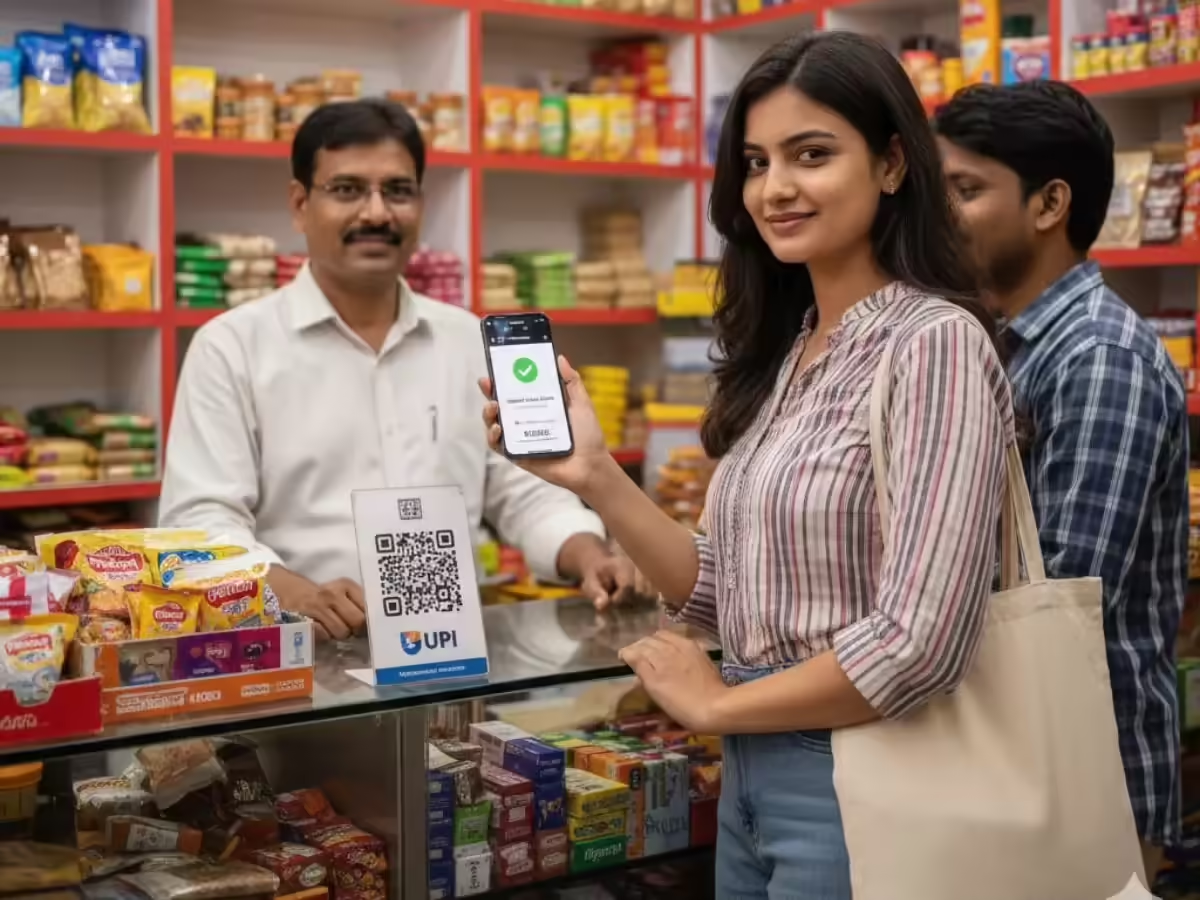
A vegetable seller in Bengaluru holds up a QR code.
A customer scans it.
The phone vibrates.
₹50 paid.
No cash changes hands.
No card machine is required.
No signature is required.
No obvious transaction fee appears.
For the customer, the experience feels almost magical.
But behind that ₹50 payment sits an extraordinarily complicated financial infrastructure involving banks, the National Payments Corporation of India, payment service providers, third-party application providers, telecommunications networks, cybersecurity systems, regulators, merchant-acquiring infrastructure and, in some cases, government incentives.
And almost none of that infrastructure is visible to the person buying the vegetables.
This leads to one of the most important questions in India’s digital economy:
If UPI costs the customer and merchant almost nothing, who pays for UPI?
The answer reveals something much bigger than the economics of a payment application.
It reveals how India has attempted to build digital public infrastructure as an economic utility.
As of August 2026, UPI processed 24.51 billion transactions in a single month, worth approximately ₹29.82 lakh crore. NPCI reported 752 banks live on the platform.
At that scale, UPI is no longer merely a payment product.
It is infrastructure.
And infrastructure always has an economic model.
THE GREAT UPI ILLUSION
Free at the Front End. Expensive at the Back End.
The most common description of UPI is:
“UPI is free.”
That statement is useful for consumers but economically incomplete.
A UPI transaction requires infrastructure.
There are costs associated with:
- bank technology;
- payment switching;
- network connectivity;
- cybersecurity;
- authentication;
- fraud detection;
- dispute resolution;
- merchant acquisition;
- QR deployment;
- customer support;
- compliance;
- reconciliation;
- settlement;
- software development;
- data centres and cloud infrastructure;
- monitoring and operational teams.
The user simply doesn’t see those costs.
That is the first principle of understanding UPI:
Zero price does not mean zero cost.
Instead, India has created a system in which the visible transaction price is deliberately suppressed, while the underlying ecosystem is supported through several different economic mechanisms.
That distinction is fundamental.
What Does a UPI Transaction Actually Cost?
There is no single universal “UPI cost.”
The economics depend upon:
- whether it is P2P or P2M;
- the payment instrument used;
- the merchant category;
- transaction value;
- whether a government incentive applies;
- the participating banks;
- the application;
- the specific commercial arrangement;
- whether the payment is domestic or international.
This is why statements such as “UPI costs the government X paise per transaction” can be misleading unless the transaction category and scheme are clearly defined.
The better question is:
Who bears which cost at each layer of the UPI ecosystem?
That is the question this investigation attempts to answer.

THE MACHINE BEHIND THE QR CODE
UPI Is a Network, Not an App
One of the biggest misunderstandings about UPI is that people treat it as if it were a single consumer application.
It isn’t.
You can use UPI through multiple applications and banks because UPI is an interoperable payment rail.
The Reserve Bank of India describes UPI as an open-loop payment system in which NPCI owns and operates the infrastructure while third-party application providers build consumer-facing applications and work with payment service provider banks.
A simplified architecture looks like this:
CUSTOMER
↓
UPI APPLICATION
↓
PSP BANK
↓
NPCI / UPI NETWORK
↓
BANKING SYSTEM
↓
MERCHANT’S BANK
↓
MERCHANT
The important insight is that no single participant necessarily performs every function.
NPCI: The Rail Operator
At the heart of the system is the National Payments Corporation of India.
NPCI provides the common payment infrastructure that enables participating institutions to communicate and transact across the network.
NITI Aayog’s 2026 DPI@2047 roadmap describes UPI as a shared digital capability under RBI oversight, with NPCI functioning as the not-for-profit system provider and operator.
That institutional structure matters.
Imagine if every bank created its own railway track.
Bank A’s customers could easily transact with Bank A.
Bank B’s customers could transact with Bank B.
But moving between the two systems would require bilateral arrangements.
UPI effectively creates a common rail.
The banks and applications can compete above it.
WHY THE GOVERNMENT MADE UPI CHEAP
Zero MDR Was a Strategic Policy Choice
The economic heart of UPI is MDR — Merchant Discount Rate.
MDR is the fee associated with processing certain merchant payments.
Traditional card payments provide a useful comparison.
Suppose a merchant accepts a ₹1,000 card payment and a 1% MDR applies.
The merchant’s economics could look roughly like:
₹1,000 transaction
minus
₹10 payment-processing charge
equals
₹990 net
The fee helps support the payment ecosystem.
UPI was deliberately designed differently.
The Government of India introduced a zero-MDR framework for prescribed UPI transactions from January 1, 2020. RBI’s benchmarking report explicitly records the government’s direction that MDR not be collected for UPI and RuPay debit-card transactions.
This was a major policy intervention.
It meant that the smallest merchant could accept digital payment without treating every transaction as an additional operating expense.
For a large retailer, a tiny payment-processing fee may be manageable.
For a street vendor selling ₹20, ₹30 or ₹50 items, even a small percentage can matter.
India effectively made a strategic calculation:
Remove the price barrier and maximise adoption.
The Logic Was Simple
Consider two worlds.
World A
Merchant accepts cash.
Cost appears to be:
₹0 transaction fee
World B
Merchant accepts digital payment.
Cost:
₹X transaction fee
The merchant has a reason to prefer cash.
But remove the fee:
World C
Merchant accepts UPI.
Cost:
₹0 MDR
Now digital acceptance becomes easier to justify.
RBI has explicitly noted the trade-off involved in payment-system pricing: high costs can discourage adoption, while costs that are too low can make systems non-remunerative and discourage investment. RBI describes the objective as creating a high-volume, low-average-value, low-cost payment environment.
That sentence goes a long way toward explaining India’s UPI philosophy.
SO WHO PAYS?
The Answer Is: The Ecosystem
There is no single organisation that simply receives a government cheque for every UPI payment.
The economics are distributed.
A simplified model is:
GOVERNMENT
Policy + incentives
↓
NPCI
Shared payment infrastructure
↓
BANKS
Accounts + payment processing + settlement functions
↓
PSPs / TPAPs
Connectivity + consumer interface
↓
MERCHANT
Digital acceptance
The precise compensation varies according to transaction type and applicable rules.
But the important point is:
The absence of MDR moves the economics away from a simple merchant-fee model.
That is the defining feature.
THE GOVERNMENT SUBSIDY
The ₹2,000-Crore Question
If merchants are not paying MDR, policymakers still face the problem of maintaining economic incentives for ecosystem participants.
This is where government incentive schemes become important.
For FY2026-27, the Department of Financial Services’ Outcome Budget provides a ₹2,000 crore financial outlay for the incentive scheme promoting RuPay debit cards and low-value BHIM-UPI person-to-merchant transactions. The document sets targets including increased UPI acceptance infrastructure and growth in BHIM-UPI merchant transactions.
This is one of the most important numbers in understanding the current UPI economics.
It demonstrates that government support is not an accidental side effect.
It is an explicit policy instrument.
It Was Not Always ₹2,000 Crore
The subsidy model has evolved.
The Department of Financial Services reports that the FY2021-22 scheme had an estimated outlay initially set at ₹1,300 crore and subsequently enhanced to ₹1,450 crore, with actual expenditure of approximately ₹1,389 crore.
For FY2022-23, the estimated outlay was ₹2,600 crore, with approximately ₹2,210 crore ultimately spent after committed liabilities.
For FY2024-25, the government notified an incentive scheme for low-value BHIM-UPI P2M transactions with an estimated outlay of ₹1,500 crore. As of November 30, 2025, actual expenditure was approximately ₹1,046 crore.
The trajectory tells us something important.
India has been willing to spend public money to preserve the economics of extremely low-cost digital payments.
HOW THE MONEY FLOWS
The Payment Is Free. The Ecosystem Still Has Economics.
This is where the subject becomes complicated.
The government incentive isn’t simply:
Government → PhonePe
or
Government → Google Pay
The architecture involves banks and other participants.
Government documents describe the incentive framework around acquiring banks and the ecosystem supporting eligible transactions.
The simplified economic chain is:
Government incentive
↓
Eligible payment ecosystem
↓
Acquiring bank
↓
Issuer / PSP / application ecosystem
The exact distribution depends upon the scheme and applicable rules.
This is why it is inaccurate to say:
“The government pays UPI.”
The government supports specific transaction economics under specific schemes.
UPI itself is an entire ecosystem.
The Acquirer
The acquiring side is associated with the merchant.
The acquirer enables the merchant to receive the payment and participates in the settlement process.
Think of the acquirer as the merchant-side banking relationship.
When a customer scans a merchant QR code, the merchant’s banking/payment infrastructure must recognise, receive and reconcile the payment.
That requires technology.
The Issuer
The issuer is generally the bank associated with the customer’s account/payment instrument.
The issuer authenticates and processes the customer’s side of the transaction.
Thus a simple ₹100 payment can involve:
Customer’s bank
plus
customer’s application
plus
PSP
plus
NPCI
plus
merchant’s bank
plus
merchant infrastructure
The customer experiences:
“Scan → PIN → Paid.”
The financial system experiences:
“Authenticate → route → validate → process → settle → reconcile → monitor → report.”
THE BUSINESS MODEL OF PHONEPE, GOOGLE PAY AND OTHER UPI APPS
If UPI Is Free, How Can Fintechs Build Businesses?
This may be the most misunderstood part of the entire system.
If a UPI app cannot simply charge the merchant a conventional transaction fee, where does its business model come from?
The answer is:
The payment itself can be the distribution mechanism rather than the final product.
A consumer might enter a fintech application to make a ₹200 payment.
But the platform can potentially build commercial services around that relationship.
Those may include:
- financial products;
- lending;
- insurance;
- wealth and investment products;
- merchant services;
- bill-payment services;
- commerce;
- subscriptions;
- advertising;
- software services;
- credit products.
The strategic value of UPI therefore extends beyond transaction revenue.
It creates:
frequency
engagement
customer relationships
merchant relationships
financial data
distribution
The Super-App Economics
Imagine a user opens a UPI app several times a week.
Each payment may generate little or no direct revenue.
But the app has achieved something extraordinarily valuable:
habit.
The user trusts the application.
The merchant recognises the brand.
The app becomes a gateway into financial services.
This changes the economics.
The business model becomes:
Payments
↓
User acquisition
↓
Habit formation
↓
Engagement
↓
Financial products
↓
Revenue opportunities
UPI can therefore function as a customer-acquisition engine.
NITI AAYOG’S BIG IDEA
UPI as Digital Public Infrastructure
NITI Aayog’s 2026 DPI@2047 for Viksit Bharat roadmap provides perhaps the most important conceptual framework for understanding UPI.
The report argues that India’s digital public infrastructure model uses shared capabilities to enable market innovation.
The report identifies UPI as a shared, interoperable capability and distinguishes the infrastructure layer from the application layer.
This distinction is critical.
Infrastructure layer
Common.
Interoperable.
Shared.
Scalable.
Application layer
Competitive.
Private-sector participation.
Consumer experience.
Innovation.
Different business models.
That is almost the opposite of the traditional vertically integrated technology company.
The Railway Analogy
Imagine Indian Railways built tracks but allowed thousands of companies to innovate around train services.
The track would be infrastructure.
The trains would be applications.
The passengers would be users.
The businesses would compete around services.
UPI follows a broadly similar philosophy.
The payment rail provides the shared infrastructure.
Banks and technology companies build services above it.
NITI Aayog’s DPI@2047 roadmap explicitly describes UPI’s success as arising from this shared infrastructure combined with ecosystem participation and continuous evolution.
THE HIDDEN VALUE OF UPI
The Payment May Be Worth More Than the Fee
There is a deeper economic argument behind UPI.
A digital transaction creates a record.
A cash transaction can disappear into the physical economy.
A digital transaction can become part of a merchant’s financial history.
NITI Aayog’s 2026 roadmap highlights this phenomenon, noting that transaction histories can create verifiable cash-flow records and potentially help small businesses access formal credit.
Consider a small shop.
Before digital payments:
Sales
₹1,000
₹2,000
₹500
₹3,000
mostly cash.
Financial institution sees limited evidence.
After digital payments:
Daily transaction history
₹1,000
₹2,000
₹500
₹3,000
₹4,500
₹2,200
₹5,000
Now there is a digital trail.
That trail can potentially become economically useful.
It may help support:
- accounting;
- cash-flow analysis;
- credit assessment;
- merchant services;
- formalisation;
- financial planning.
The transaction therefore has second-order value.
That is one reason the economics of UPI cannot be measured purely by MDR.
WHY INDIA IS WILLING TO PAY
UPI Is Infrastructure Policy, Not Merely Payment Policy
Why would a government spend thousands of crores supporting digital payment adoption?
Because the objective is not necessarily to make money from the transaction.
The objective can be to create a more efficient digital economy.
NITI Aayog’s DPI framework describes shared digital capabilities as mechanisms for reducing structural transaction costs, increasing productivity and expanding market access.
That creates a different equation.
Instead of:
UPI transaction revenue − UPI transaction cost
the policy question becomes:
Digital infrastructure investment → economic productivity
That is a much larger equation.
THE CASH COMPARISON
Cash Is Not Free Either
There is another misconception worth dismantling.
People sometimes say:
“Cash costs nothing.”
But cash has an economic cost.
Currency has to be:
- printed;
- transported;
- secured;
- stored;
- counted;
- distributed;
- replaced;
- managed.
RBI has explicitly pointed out that cash carries significant social costs, including the costs associated with printing, distributing and maintaining currency.
A merchant may perceive cash as free.
The economy does not.
The real comparison is therefore not:
free UPI vs expensive cash.
It is:
different forms of economic infrastructure with different cost structures.
THE NETWORK EFFECT
Why UPI Became So Powerful
Payment networks have a unique characteristic:
Their value increases as participation increases.
Imagine a payment system with:
10 customers
10 merchants
Useful.
Now:
1 million customers
1 million merchants
Much more useful.
Now:
hundreds of millions of customers
millions of merchants
hundreds of participating banks
The network becomes difficult to replicate.
NPCI’s August 2026 figures—24.51 billion transactions in one month across 752 live banks—illustrate the scale at which this network effect now operates.
The UPI flywheel looks like this:
Low merchant cost
↓
More merchants
↓
More acceptance
↓
More consumers
↓
More transactions
↓
More applications
↓
More financial services
↓
More economic utility
↓
More adoption
This is not simply a payment product.
It is a network economy.
WHY SCALE CHANGES THE ECONOMICS
₹100 Billion Transactions Would Not Mean ₹100 Billion of Revenue
This is another critical distinction.
Payment volume is not revenue.
Suppose a system processes:
₹100 lakh crore
That does not mean the network earns:
₹100 lakh crore.
The transaction value is simply the amount of money transferred.
The business model depends on the fees, incentives, commercial services and economic relationships surrounding the transaction.
UPI’s enormous transaction value therefore should not be interpreted as NPCI or fintech revenue.
This distinction should be obvious—but is frequently lost in discussions about UPI.
NPCI’S BUSINESS MODEL
A Network Operator Is Different From a Fintech App
NPCI occupies a different economic position from a consumer fintech.
Its role is to operate payment infrastructure and facilitate interoperability.
That means its economics are fundamentally linked to:
- network operations;
- switching;
- technology;
- settlement;
- infrastructure;
- participant services;
- payment-system rules.
NPCI’s own UPI documentation and circulars demonstrate that the ecosystem has transaction-specific rules and charges, including switching-related arrangements in particular circumstances.
Therefore:
“UPI is free”
does not mean:
“nobody in the UPI ecosystem ever pays any fee.”
The actual pricing architecture is more granular.
NOT EVERY UPI TRANSACTION IS ECONOMICALLY IDENTICAL
P2P Versus P2M
There is a crucial distinction between:
P2P
Person-to-person.
Example:
You send ₹2,000 to a friend.
P2M
Person-to-merchant.
Example:
You pay ₹2,000 at a restaurant.
The policy and incentive discussion around UPI has often focused particularly on low-value P2M transactions, because merchant acceptance is central to the digitalisation of everyday commerce.
The government’s FY2026-27 incentive framework specifically targets low-value BHIM-UPI P2M transactions.
That is important because the policy objective is not simply:
“Make all money transfers free.”
It is also:
“Create ubiquitous digital merchant acceptance.”

THE ₹2,000 MISUNDERSTANDING
Does UPI Become Chargeable Above ₹2,000?
No general rule says:
₹2,000 = free
and
₹2,001 = chargeable.
That interpretation confuses the eligibility criteria of particular incentive schemes with the overall UPI pricing architecture.
The ₹2,000 threshold has been relevant to specific low-value transaction incentive arrangements.
It should not be presented as a universal UPI price threshold.
This distinction is particularly important for financial journalism because inaccurate descriptions of the threshold can create confusion among merchants and consumers.
THE INTERNATIONAL DIMENSION
UPI Is Becoming More Than an Indian Payment Rail
UPI’s economics become even more interesting when the system crosses borders.
NPCI’s international initiatives include UPI Global Acceptance, allowing users to make QR-based payments at participating international merchant locations from Indian bank accounts through UPI-enabled applications.
NPCI also supports UPI services for eligible NRIs using NRE/NRO accounts and international mobile numbers, subject to participating bank and application arrangements.
International payments introduce additional economic variables:
- foreign exchange;
- partner networks;
- cross-border settlement;
- merchant acquiring;
- regulatory requirements;
- international acceptance;
- commercial arrangements.
That means the economics of domestic UPI and international UPI should not automatically be treated as identical.
THE NEXT UPI BUSINESS MODEL
From Payments to Financial Infrastructure
The most interesting possibility is that UPI gradually becomes the foundation for a much broader financial ecosystem.
Imagine:
UPI
↓
Merchant identity
↓
Transaction history
↓
Cash-flow intelligence
↓
Credit
↓
Insurance
↓
Investment
↓
Working capital
↓
Business software
At that point, the original payment may be almost incidental.
The payment becomes the first interaction.
The financial ecosystem becomes the monetisation layer.
THE BIG QUESTION: IS ZERO MDR SUSTAINABLE?
This is where the debate becomes serious.
RBI itself has recognised the tension.
A payment system needs to be:
cheap enough to encourage adoption
but also:
economically sustainable enough to encourage investment.
RBI’s 2022 benchmarking study explicitly identified this tension between high costs discouraging adoption and very low costs potentially making payment systems non-remunerative.
UPI has solved the adoption problem spectacularly.
The next question is:
How should India solve the long-term sustainability problem?
THREE POSSIBLE FUTURES
Model One: Continue Government Support
The government continues providing incentives for eligible transactions.
Advantages:
- preserves zero-cost merchant acceptance;
- protects small merchants;
- supports adoption.
Challenge:
- recurring fiscal expenditure.
Model Two: Introduce Selective Commercial Pricing
Another possibility is differentiated pricing.
For example:
small merchants → ₹0
micro-transactions → ₹0
large enterprise payments → commercial pricing
premium services → commercial pricing
This could create a revenue pool without directly imposing costs on India’s smallest merchants.
But pricing policy can affect merchant behaviour.
Model Three: Monetise the Ecosystem Around Payments
The payment remains free.
The money is made elsewhere.
For example:
Payments → customer acquisition
Payments → merchant services
Payments → lending
Payments → insurance
Payments → wealth
Payments → advertising
Payments → software
This may be the most technologically interesting model.
The transaction becomes infrastructure for the relationship.
THE FINTECH DILEMMA
Scale Is Not the Same as Profit
UPI created extraordinary transaction scale.
But scale creates a different problem:
Who captures the economic value?
Consumers receive convenience.
Merchants receive low-cost acceptance.
Banks receive payment activity.
Fintech applications receive user engagement.
NPCI operates the network.
Government receives broader digitalisation benefits.
But the question remains:
Which participant captures enough monetary value to justify long-term investment?
That is the central business-model question.
THE DATA QUESTION
Is the Payment More Valuable Than the Payment Fee?
Digital payments generate transaction records.
But transaction data is not automatically equivalent to free monetisable data.
Financial institutions operate under privacy, security, regulatory and data-governance requirements.
The economic opportunity lies less in simply “selling payment data” and more in the ability of authorised institutions to use appropriate transaction information and consent-based financial infrastructure to develop services.
This distinction will become increasingly important as India develops its broader digital public infrastructure.
UPI AND MSMEs
The Small Merchant May Be the Biggest Beneficiary
Consider a small business operating without sophisticated financial software.
UPI can provide:
- digital receipts;
- transaction history;
- easier reconciliation;
- remote payment acceptance;
- reduced cash-handling requirements;
- potentially stronger financial records.
NITI Aayog’s DPI@2047 roadmap explicitly links UPI transaction histories with the possibility of improving access to formal credit for small businesses through verifiable digital cash-flow records.
This is why the economic impact of UPI should not be measured solely by transaction fees.
Its impact can extend into:
credit
commerce
formalisation
productivity
financial inclusion
UPI AS A DIGITAL PUBLIC UTILITY
India’s Most Interesting Technology Experiment May Not Be an App
The world’s technology industry spent decades building private platforms.
India took another route.
Build common infrastructure.
Make it interoperable.
Allow private companies to compete above it.
The result is a structure in which:
Government
sets policy and provides strategic support.
RBI
regulates the payment system.
NPCI
operates shared infrastructure.
Banks
provide regulated financial accounts and payment connectivity.
Fintechs
build applications and services.
Merchants
provide acceptance points.
Consumers
drive demand.
That is a remarkably different model from a conventional vertically integrated technology company.

THE UPI FLYWHEEL 2.0
The first generation of UPI was about:
Payments.
The next generation could be about:
Economic identity + commerce + credit + financial services.
The evolution could look like:
Phase 1
Digital payment
↓
Phase 2
Merchant acceptance
↓
Phase 3
Transaction history
↓
Phase 4
Financial access
↓
Phase 5
Credit and business services
↓
Phase 6
Cross-border payments
↓
Phase 7
Digital economic infrastructure
That is a much larger opportunity.
THE ₹0 BUSINESS MODEL EXPLAINED
Let’s reduce the entire UPI economy to one page.
CUSTOMER
Usually sees:
₹0 direct fee
↓
MERCHANT
For covered UPI transactions:
₹0 MDR
↓
APPLICATION
May receive economic value through applicable arrangements and broader financial/commercial services.
↓
PSP BANK
Provides connectivity and banking infrastructure.
↓
ISSUER BANK
Provides the customer’s account/payment infrastructure.
↓
ACQUIRER BANK
Supports merchant acceptance and settlement.
↓
NPCI
Operates the shared UPI payment infrastructure.
↓
GOVERNMENT
Provides policy support and, under specified schemes, financial incentives.
↓
ECONOMY
Receives broader benefits from:
digitalisation
formalisation
financial inclusion
lower payment friction
merchant digitisation
potentially improved access to formal financial services
That is the real UPI business model.
THE BIG MISCONCEPTION
UPI Is Not a Free Payment System
It is a low-price-to-user payment system whose economics are distributed across an ecosystem.
That is a very different proposition.
A conventional payment company asks:
How much can we charge for this transaction?
India’s UPI model asks:
How much economic activity can we create if the transaction becomes almost frictionless?
That is the philosophical difference.
WHAT NITI AAYOG SEES
NITI Aayog’s 2026 DPI@2047 report places UPI inside a much wider national technology strategy.
Its argument is essentially that shared digital capabilities can lower structural transaction costs, increase productivity and allow private-sector innovation without requiring every company to build its own infrastructure from scratch.
UPI is therefore not merely a fintech story.
It is part of India’s Digital Public Infrastructure story.
And DPI is not merely a technology story.
It is an economic architecture.
THE TECHNOCRAT VIEW
The Most Valuable Part of UPI May Be the Part That Doesn’t Charge You
For decades, the dominant assumption in digital payments was:
Payment = revenue opportunity.
India experimented with another equation:
Payment = infrastructure.
Make the transaction cheap.
Make acceptance ubiquitous.
Create interoperability.
Build scale.
Let banks and technology companies compete around the infrastructure.
Then capture economic value through the broader ecosystem.
That experiment has now reached extraordinary scale.
NPCI’s August 2026 statistics—24.51 billion transactions and ₹29.82 lakh crore in monthly transaction value—show how deeply UPI has penetrated India’s payment economy.
But scale is only the first chapter.
The next chapter is sustainability.

THE QUESTION INDIA WILL EVENTUALLY HAVE TO ANSWER
India has effectively answered one question:
How do you make digital payments ubiquitous?
UPI is the answer.
The harder question is now:
How do you sustainably finance the infrastructure once digital payments become a foundational utility?
There is no single obvious answer.
The country could continue with government incentives.
It could develop differentiated pricing.
It could monetise adjacent services.
It could allow greater commercialisation at selected layers.
Or it could continue evolving the hybrid model.
The answer will determine not merely how payment companies make money.
It could influence the architecture of India’s entire digital financial economy.
THE FINAL EQUATION
Forget the QR code for a moment.
The real UPI equation is:
LOW COST
INTEROPERABILITY
GOVERNMENT POLICY
NPCI INFRASTRUCTURE
BANKING SYSTEM
PRIVATE-SECTOR INNOVATION
MASS ADOPTION
DIGITAL PUBLIC INFRASTRUCTURE
That is why UPI is so important.
It is not simply another payment app.
It is not simply a QR code.
It is not simply a zero-MDR product.
And it is not simply a government subsidy programme.
UPI is an experiment in building an economy-wide digital utility in which the transaction can be free—or nearly free—because the economic value is created somewhere much larger than the transaction itself.
The ₹50 vegetable payment is only the visible tip.
Behind it is one of the most ambitious technology-and-economics experiments of the digital age.
And India’s next challenge isn’t proving that UPI can scale.
It already has.
The next challenge is proving that a payment system designed to be nearly free can remain economically sustainable as it becomes indispensable.
That is the real UPI business story.

TECHocrat FACT BOX
UPI at a Glance — September 2026
| Indicator | Latest available figure |
|---|---|
| UPI transactions, August 2026 | 24.51 billion |
| UPI transaction value, August 2026 | ₹29.82 lakh crore |
| Banks live on UPI | 752 |
| FY2026-27 government outlay for relevant incentive scheme | ₹2,000 crore |
| UPI zero-MDR framework | Effective from January 1, 2020 |
| UPI network operator | NPCI |
| Regulatory authority | Reserve Bank of India |
| Policy/DPI strategy | Government of India / NITI Aayog and relevant ministries |
NPCI’s monthly statistics provide the transaction figures, while the Union government’s FY2026-27 Outcome Budget provides the ₹2,000 crore incentive-scheme allocation.
TECHocrat GLOSSARY
UPI
Unified Payments Interface, India’s interoperable instant-payment infrastructure.
NPCI
National Payments Corporation of India, the organisation operating the UPI payment infrastructure.
MDR
Merchant Discount Rate, a fee associated with processing certain merchant payments.
P2P
Person-to-person payment.
P2M
Person-to-merchant payment.
PSP
Payment Service Provider bank that provides connectivity to the UPI system.
TPAP
Third-Party Application Provider, the entity providing a consumer-facing UPI application in the relevant regulatory structure.
Acquirer
The merchant-side participant/bank supporting acceptance of payments.
Issuer
The participant/bank associated with the customer’s payment account/instrument.
DPI
Digital Public Infrastructure: shared digital capabilities designed to support broad ecosystem participation and innovation.
The phrase “UPI is free” is useful shorthand—but it hides one of the most interesting stories in modern financial technology.
India did not simply invent a faster way to transfer money.
It created a shared digital rail, deliberately reduced the cost of using that rail, encouraged mass merchant adoption and allowed banks and private technology companies to build competing experiences above common infrastructure.
The experiment now sits at extraordinary scale.
The next decade will determine whether that architecture can move from digital payments infrastructure to digital economic infrastructure.
For India’s fintech industry, that transition may be more important than the QR code itself.
Primary Sources
- National Payments Corporation of India — UPI Product Statistics.
- NITI Aayog — DPI@2047 for Viksit Bharat: A Strategic Roadmap to Enable Non-linear Inclusive Socio-economic Growth, April 2026.
- Reserve Bank of India — Benchmarking India’s Payment Systems.
- Department of Financial Services — Annual Report 2025-26.
- Government of India — Outcome Budget 2026-27, Department of Financial Services.
- NPCI — UPI circulars and UPI Global Acceptance documentation.

Comments