
27 Aug 2026 | TECHNOCRAT MAGAZINE | www.ytcventures.com
Yayoi Kusama, the pioneering Japanese avant-garde artist whose vibrant polka dots, pumpkin sculptures and immersive Infinity Mirror Rooms made her one of the most recognisable and commercially successful figures in contemporary art, has died at the age of 97.Her studio and the Yayoi Kusama Foundation announced the news on Thursday, confirming that she passed away at a hospital in Tokyo on 14 August 2026. Some reports cited multiple organ failure as the cause.
A private funeral for close family has already been held, with a public memorial planned for a later date.In an official statement, Yayoi Kusama Inc. and her studio said: “Throughout an extraordinary lifetime devoted entirely to artistic creation, Kusama pursued an internationally acclaimed career as a pioneering avant-garde artist whose creative practice encompassed visual art, performance, fiction, and poetry. She continued to paint until her final days, never setting aside her brush, and continued exploration of forever love and eternal soul. We will carry forward Kusama’s wishes and, through art, continue to bring hope and strength for the future to people around the world.”
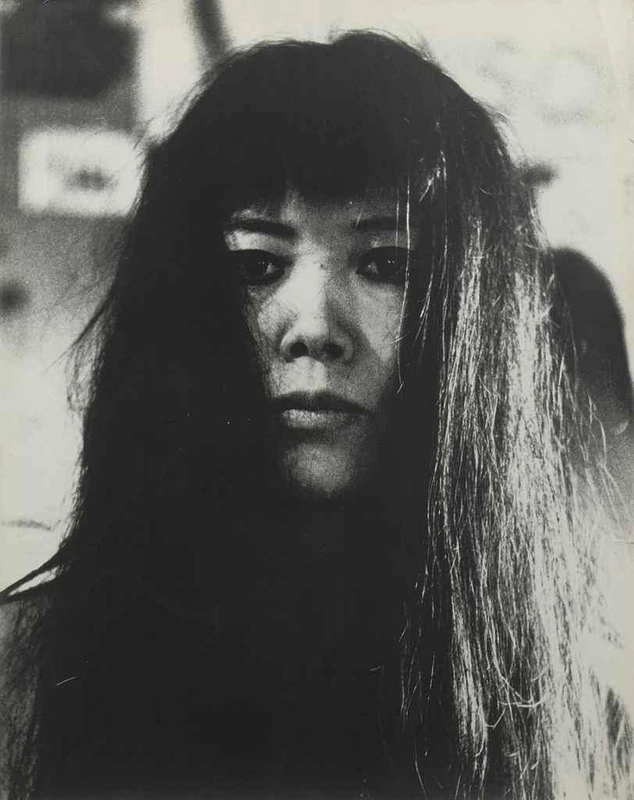
From childhood visions to global icon
Born on 22 March 1929 in Matsumoto, Nagano Prefecture, Kusama experienced vivid hallucinations from an early age. She later channelled those visions — of dots covering her body, the room and the world around her — into a lifelong artistic practice. “Dots come flying everywhere,” she once said. Art, she repeatedly explained, was her means of survival.She moved to New York in the late 1950s, where she became a notable presence in the city’s avant-garde scene of the 1960s with her “Infinity Nets” paintings, soft sculptures, Happenings and radical performances.
After returning to Japan in the 1970s, she voluntarily lived in a psychiatric hospital in Tokyo for decades while continuing to work at a prolific pace from a nearby studio.In her later years Kusama achieved extraordinary global fame. Her Infinity Mirror Rooms drew massive crowds and became social-media sensations. Major retrospectives broke attendance records, her works regularly sold for millions at auction, and collaborations (including with Louis Vuitton) introduced her signature polka dots to an even wider audience.
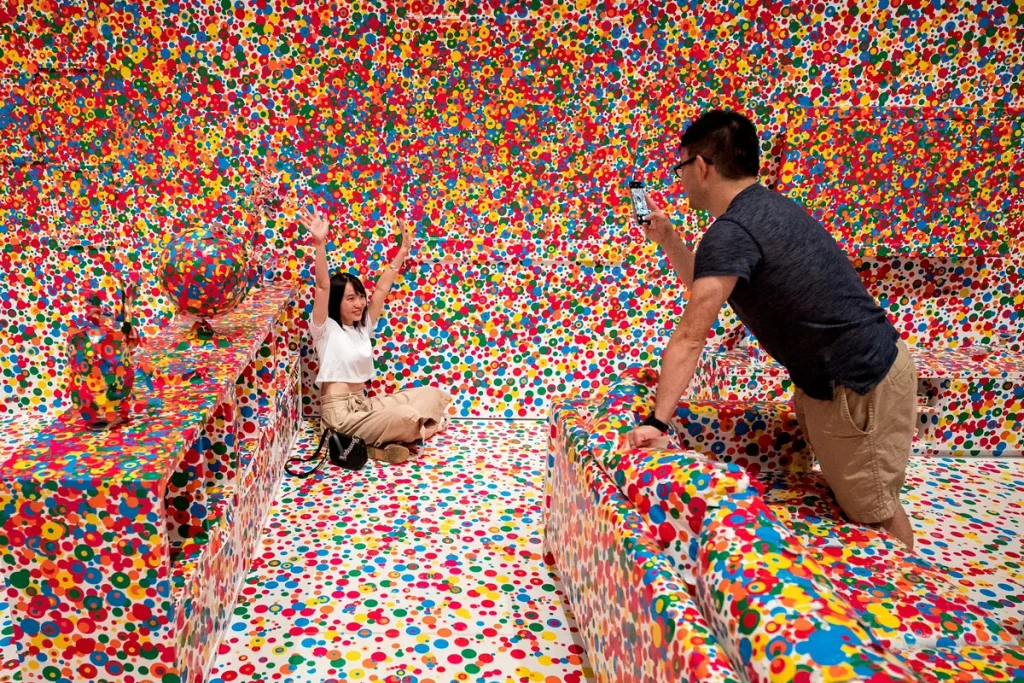
By the time of her death she was widely regarded as the most famous living artist in the world.Dealer David Zwirner, who represented her for many years, said she “was without a doubt the most famous living artist in the world” at the time of her passing, praising her “steadfast message of love and peace.”Kusama’s work combined personal trauma, psychological intensity and joyful, hypnotic repetition. Through endless dots, nets and mirrored spaces she sought both to confront her fears and to dissolve the self into infinity. Her legacy — as an artist, a survivor and a cultural phenomenon — will continue to resonate in museums, galleries and popular culture worldwide.
Yayoi Kusama: A Life of Infinity, Obsession, and Survival
Yayoi Kusama (March 22, 1929 – August 14, 2026) was a Japanese artist whose singular vision of polka dots, nets, pumpkins, and mirrored infinity transformed the landscape of contemporary art. Over a career spanning more than seven decades, she worked across painting, sculpture, installation, performance, fashion, literature, and film. She described herself as an “obsessional artist,” channeling lifelong hallucinations and psychological struggles into a philosophy she called “self-obliteration.” By the time of her death at 97, she was widely regarded as one of the most famous and commercially successful artists in the world.
Early Life in Matsumoto (1929–1957)
Yayoi Kusama was born on March 22, 1929, in Matsumoto, a provincial city in Nagano Prefecture in the Japanese Alps. She was the youngest of four children in a relatively affluent family that operated a large plant nursery and seed business. The family grew flowers and vegetables on extensive land that included greenhouses rare for the era. Surrounded by fields of violets, peonies, and zinnias, young Kusama developed an early love of nature and drawing.Her childhood was marked by deep family conflict. Her parents’ marriage was arranged and unhappy.
Her father was frequently absent and had extramarital affairs; her mother, described by Kusama as physically and verbally abusive, once ordered the young girl to spy on her father’s liaisons. These experiences left Kusama with a lasting fear of sex and male sexuality that would later surface powerfully in her art.From around the age of ten, Kusama began experiencing vivid visual and auditory hallucinations. She described seeing the patterns of a tablecloth multiply and cover the walls, ceiling, and her own body, or hearing the voices of plants and animals.
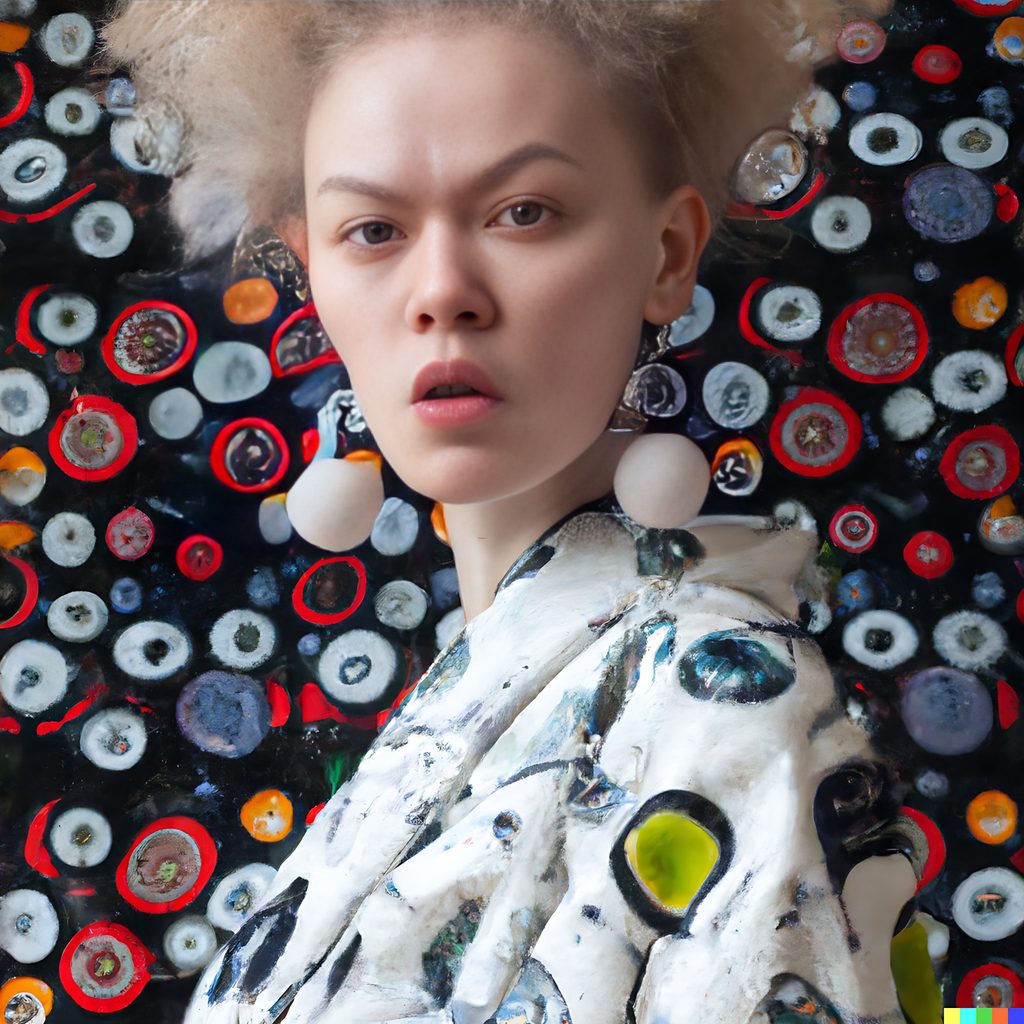
Dots and nets appeared everywhere. To manage these overwhelming visions, she began drawing and painting them obsessively. “I paint them,” she later said of the dots that filled her world. Art became both a coping mechanism and a form of self-therapy.During World War II, at about age 13–15, Kusama was conscripted with other schoolgirls to work in a military parachute factory.
The repetitive sewing work and the atmosphere of wartime Japan left a strong impression. After the war, despite her family’s opposition (her mother wanted her to marry and become a conventional housewife), she persuaded them to allow her to study art. In 1948–49 she attended the Kyoto Municipal School of Arts and Crafts, where she trained in traditional nihonga (Japanese-style painting). Frustrated by its rigid conventions, she largely taught herself oil painting and developed her own experimental style using watercolors, pastels, and oils.In the early 1950s she held local exhibitions in Matsumoto and other Japanese cities. Feeling stifled by conservative Japanese society and the limited opportunities for women artists, she sought a way out. In 1955 she wrote to the American artist Georgia O’Keeffe, seeking advice.
O’Keeffe responded encouragingly. In November 1957, at age 27, Kusama left Japan for the United States. Before departing, she destroyed hundreds of her early works by burning them on a riverbank near her home—a symbolic break with her past. She arrived first in Seattle, where she had a small solo show, then moved to New York in 1958 with little money (some sewn into her clothes), a few silk kimonos, and intense ambition.
The New York Years: Breakthrough and Avant-Garde Fame (1958–1973)
New York proved both liberating and extremely difficult. Kusama lived in poverty, sometimes scavenging food and working in unheated studios through harsh winters. She painted obsessively, creating her first major series: the Infinity Nets. These large-scale monochromatic canvases, covered edge-to-edge with tiny, repetitive looping brushstrokes, evoked endless nets or cellular structures without beginning, end, or center. Shown at the Brata Gallery in 1959, they drew critical attention. Donald Judd became an early supporter and friend; he and Frank Stella bought works from her. The nets were both formal experiments that anticipated Minimalism and personal acts of meditation that helped Kusama manage her hallucinations.In the early 1960s she expanded into three-dimensional work.
Her Accumulations (or soft sculptures) covered everyday furniture—chairs, sofas, ladders, a rowboat—with hundreds of hand-sewn, stuffed fabric phallic forms. These pieces transformed ordinary objects into fields of obsessive, sexualized growth. Kusama explained that she made them to confront and neutralize her fear of the phallus and sex. Related installations, such as the 1963–64 Aggregation: One Thousand Boats Show, filled rooms with repeated imagery.In 1965 she created her first Infinity Mirror Room—Phalli’s Field, a mirrored chamber filled with red-polka-dotted soft sculptures that multiplied infinitely in the reflections. These immersive environments would become her most iconic contribution to art.
She also staged dozens of “Happenings”—performance events in which she painted polka dots on the bodies of nude participants, often in public spaces. These works, sometimes framed as anti-war or anti-establishment protests during the Vietnam era, attracted media attention and occasional police intervention. In 1966, at the Venice Biennale, she unauthorizedly installed Narcissus Garden: 1,500 mirrored spheres on a lawn, which she tried to sell for two dollars each under a sign reading “Your Narcissism for Sale.” Officials shut the action down.Kusama moved in circles that included Andy Warhol (whom she later accused of appropriating ideas), Claes Oldenburg, and others. She had a significant, largely platonic relationship with the artist Joseph Cornell. Despite growing recognition, she remained an outsider as a Japanese woman in a male-dominated New York scene. By the early 1970s, financial pressures, exhaustion, the death of Cornell in 1972, and her father’s death in 1974 took a heavy toll. In 1973 she returned to Japan.
Return to Japan and Voluntary Institutionalization (1973–1990s)
Back in Tokyo, Kusama initially faced isolation and a hostile reception. In 1977 she voluntarily admitted herself to a psychiatric hospital, where she would live for the rest of her life.
She maintained a studio nearby and continued working with remarkable discipline, commuting daily to create. During this period she also wrote surreal novels, short stories, and poetry, including works that explored themes of sex, death, and the body. She began incorporating pumpkins more prominently into her sculpture and painting—forms she associated with comfort and a kind of self-portraiture from childhood.Her international reputation was quietly rebuilt in the late 1980s. A major retrospective organized by Alexandra Munroe at the Center for International Contemporary Arts in New York in 1989 helped reintroduce her 1960s achievements to a new generation of critics and curators. In 1993 she became the first artist to receive a solo presentation in the Japanese pavilion at the Venice Biennale, showing mirrored pumpkin installations.
Global Stardom (2000s–2026)
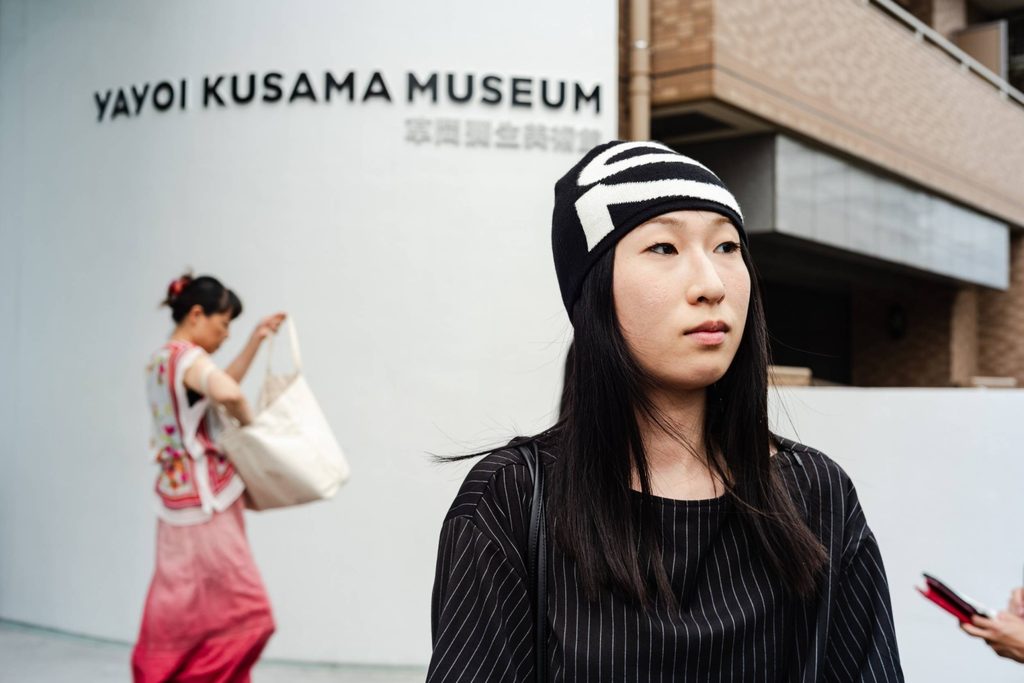
From the 2000s onward, Kusama’s fame exploded. Major retrospectives traveled the world, including shows at Tate Modern, the Whitney Museum, the Centre Pompidou, and many others. The 2017–2019 touring exhibition Yayoi Kusama: Infinity Mirrors, which originated at the Hirshhorn Museum, drew record crowds and turned her mirrored rooms into social-media destinations. In 2017 the Yayoi Kusama Museum opened in Tokyo’s Shinjuku district. Collaborations with Louis Vuitton brought her dots into fashion and popular culture on a massive scale.She continued producing at a ferocious pace.

Between 2009 and 2021 she created roughly 900 paintings in the My Eternal Soul series. In 2021 she began a new body of work titled Every Day I Pray for Love. Her auction prices soared; one early Infinity Net painting sold for $10.5 million in 2022. She received Japan’s highest cultural honors, including the Order of Culture in 2016, as well as international awards such as the Praemium Imperiale.Throughout her later decades she remained based at the psychiatric hospital while maintaining a rigorous studio practice. She often appeared in public in her signature bright-red wig and polka-dot clothing, projecting a carefully constructed persona that blended vulnerability, theatricality, and steely determination.
Themes, Philosophy, and Legacy
Kusama’s art was inseparable from her inner life. The dots and nets represented both the terrifying proliferation of her hallucinations and a means of dissolving the self into the cosmos—“self-obliteration.” Pumpkins offered a softer, more grounded counterpoint. Infinity, repetition, accumulation, and the merging of the individual with the infinite were constant preoccupations. She once said: “Our earth is only one polka dot among a million stars in the cosmos.”She never married or had children.
Relationships with artists such as Cornell were intense but complex. Art, she insisted repeatedly, was the force that kept her alive: “If it hadn’t been for art, I would have killed myself a long time ago.”Yayoi Kusama died on August 14, 2026, at a hospital in Tokyo from multiple organ failure. She was 97. Her studio announced that she continued to paint until her final days.
A private funeral was held for family; a public memorial was planned. At the time of her death she was widely described as the most famous living artist in the world.Her legacy is immense. She influenced Minimalism, Pop, performance, installation, and feminist art. She expanded the possibilities of immersive environments and demonstrated that obsession, mental struggle, and radical formal invention could coexist in a single, enduring practice.
Through endless dots she offered viewers a chance to experience, however briefly, the obliteration of boundaries between self and universe—an invitation that continues to draw millions into her mirrored rooms and painted fields long after her death.

Comments