
YTC Ventures | TECHNOCRAT MAGAZINE | www.ytcventures.com | Sept 7 2026
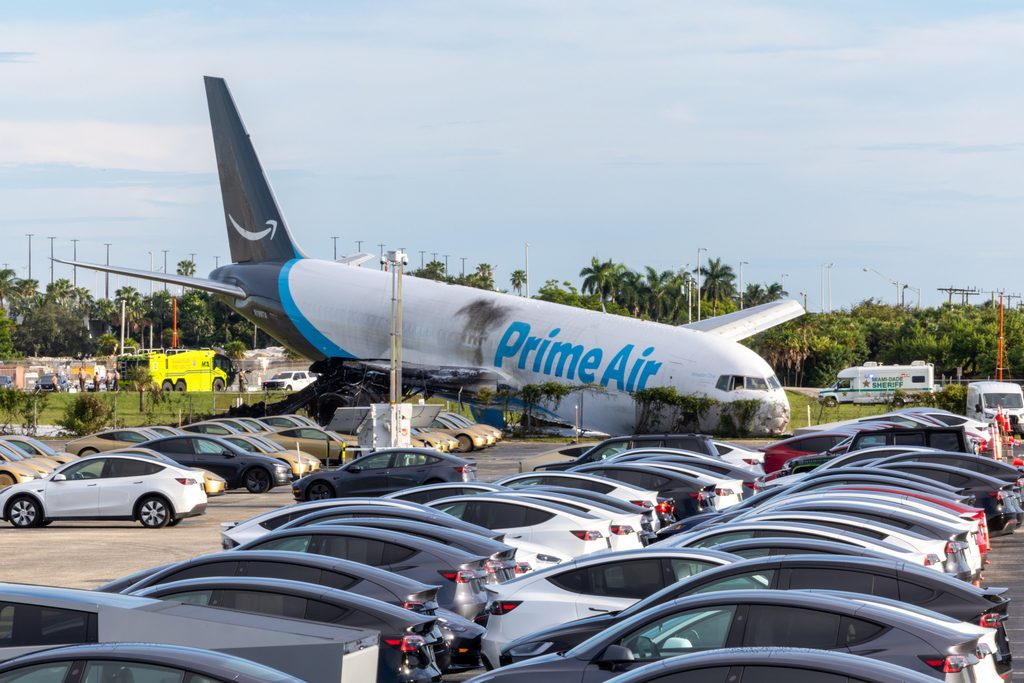
Prime Air Flight 7598, a Boeing 767 cargo aircraft operated by 21 Air, overran a runway while landing at Miami International Airport, crossed airport boundaries and struck multiple vehicles before catching fire.
MIAMI — September 7, 2026: A devastating aviation accident at Miami International Airport has left at least five people dead and five others injured after an Amazon cargo aircraft overran a runway during landing, struck multiple vehicles and caught fire.
The aircraft, identified as Prime Air Flight 7598, was a Boeing 767-300 operated by North Carolina-based 21 Air for Amazon’s cargo operation. It had departed from Luis Muñoz Marín International Airport in San Juan, Puerto Rico, before attempting to land in Miami at about 2 p.m. Sunday.
The crash sent thick black smoke into the sky and triggered a massive emergency response at one of the busiest airports in the United States.
Miami-Dade authorities confirmed five fatalities and five injuries. Three of the injured were transported to trauma centres in critical condition, while two others were taken to a hospital for treatment.
The Miami Crash: What We Know
| Detail | Latest information |
|---|---|
| Aircraft | Boeing 767-300 cargo plane |
| Flight | Prime Air Flight 7598 |
| Operator | 21 Air |
| Cargo network | Amazon Prime Air |
| Route | San Juan, Puerto Rico → Miami |
| Airport | Miami International Airport |
| Time | Around 2 p.m. local time |
| Deaths | At least 5 |
| Injured | 5 |
| Critically injured | 3 |
| Impact | Multiple vehicles struck |
| Fire | Aircraft caught fire |
| Investigation | NTSB and FAA |
The identities of the victims had not immediately been released. It also remained unclear whether all of those killed were occupants of the vehicles struck by the aircraft or whether some were aboard the plane.
How the Accident Unfolded
The aircraft was landing at Miami International Airport when it overran the runway.
Instead of stopping within the airport’s runway area, the Boeing 767 continued beyond the runway, crossed surrounding roads and struck vehicles in the area.
The impact caused a fire, with emergency crews confronting both the aircraft wreckage and people trapped in vehicles.
Fire officials described the response as complex, with victims trapped in vehicles and emergency personnel working to reach people in the wreckage.
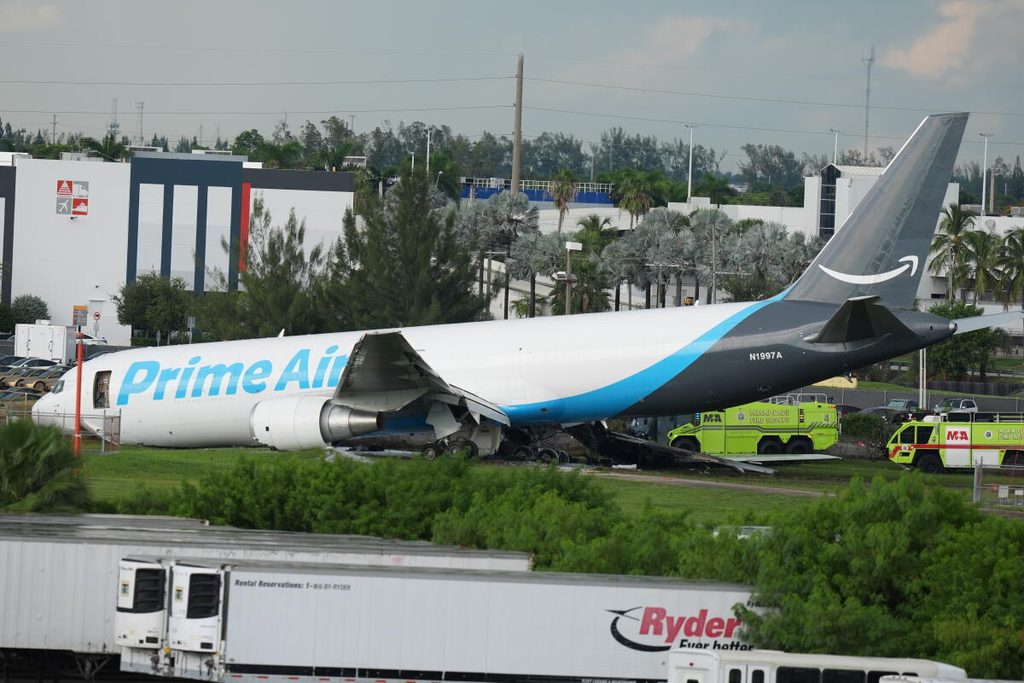
The aircraft ultimately came to rest beyond the runway in an adjacent area.
Massive Emergency Response
More than 60 Miami-Dade Fire Rescue units were dispatched to the scene.
Emergency personnel had to battle the aircraft fire while simultaneously conducting rescue operations.
The response involved firefighters, police, airport emergency teams and medical personnel.
Authorities also closed nearby roads around the airport as emergency crews worked at the crash site.
The incident brought a major portion of Miami International Airport’s operations to a standstill.
Miami Airport Operations Disrupted
The crash immediately created major disruption at Miami International Airport.
The Federal Aviation Administration issued a ground stop for inbound flights, citing the disabled aircraft and restrictions involving runways and taxiways.
The airport temporarily closed runways and taxiways while emergency teams dealt with the aircraft and secured the area.
More than 160 flights were cancelled and hundreds more delayed, according to reporting following the incident. Some flights were diverted to other airports, including Orlando.
Transportation Secretary Sean Duffy warned travellers to expect significant delays and cancellations.
For passengers travelling through Miami, one of the major aviation gateways between the United States, Latin America and the Caribbean, the crash created an immediate ripple effect across the regional air network.
What Happened to the Pilots?
The condition and circumstances involving the flight crew were among the immediate questions following the crash.
Emergency personnel reported that the pilot and co-pilot were trapped in the cockpit during the rescue operation.
Authorities had not initially released a complete account of the crew’s condition or confirmed the identities of those killed and injured.
The investigation will determine the sequence of events during the aircraft’s landing.
Was Weather a Factor?
Weather conditions are one of the factors investigators will examine.
Reports indicated that thunderstorms were in the area and winds were gusting at roughly 30 mph around the time of the accident, although rain had not yet begun at the airport when the aircraft left the runway.
That does not establish that weather caused the accident.
Investigators will need to examine the aircraft’s flight data, cockpit voice recordings, weather information, runway conditions, braking performance and the pilots’ actions before determining what happened.
NTSB and FAA Launch Investigation
The National Transportation Safety Board (NTSB) is investigating the crash, while the Federal Aviation Administration (FAA) is also examining the incident.
The investigation will likely focus on several critical questions:
Why did the aircraft fail to stop on the runway?
What were the runway and weather conditions at the time?
Was there a mechanical or braking problem?
What was the aircraft’s approach speed and landing configuration?
How did the aircraft leave the airport perimeter?
What role, if any, did wind or thunderstorms play?
Could the collision with vehicles have been prevented by airport safety infrastructure?
At this stage, no definitive cause has been established.
The Aircraft: Boeing 767-300
The aircraft involved was a Boeing 767-300, a widely used twin-engine widebody aircraft that has been employed extensively for passenger and cargo operations.
The aircraft had previously operated as a passenger aircraft before being converted for cargo use, according to reports.
That makes the incident particularly significant for the air-cargo industry.
Cargo aircraft frequently operate on tight schedules, connecting major logistics hubs overnight and during off-peak passenger hours.
Miami is particularly important because of its position as a gateway between the United States, Latin America and the Caribbean.
Why This Crash Matters Beyond Miami
This was not simply an airport accident.
Miami International Airport is a critical piece of the global logistics and aviation network.
The airport handles passenger traffic, international cargo and regional connections across the Americas.
An accident involving a major cargo aircraft therefore has consequences beyond the immediate crash site.
It raises questions about:
- Airport runway safety
- Cargo-aircraft operations
- Emergency response
- Airport perimeter protection
- Vehicle traffic around airports
- Runway-overrun prevention
- Aircraft braking systems
- Aviation safety technology
- Cargo aviation infrastructure
For the aviation industry, the investigation will be closely watched.
Amazon Responds
Amazon confirmed that the aircraft was part of its air-cargo operation and expressed concern for those affected.
The company said it was working with authorities to understand what happened and support the response.
The aircraft was operated by 21 Air, which provides cargo aviation services.
The investigation will now determine the exact circumstances surrounding the accident.
A Tragedy on the Ground and in the Air
One of the most disturbing aspects of the accident is that the aircraft did not simply leave the runway and stop.
It continued beyond the airport’s runway area and struck vehicles on the ground.
That dramatically expanded the potential danger.
Several victims were reportedly trapped in vehicles after the collision, forcing emergency crews to conduct difficult rescue operations while dealing with the aircraft fire.
The full circumstances surrounding the five deaths will be an important part of the investigation.
What Investigators Will Be Watching
Aviation investigators typically reconstruct an accident through multiple independent sources of evidence.
Flight data
The aircraft’s flight-data recorder can help establish speed, altitude, engine performance and other parameters during the approach and landing.
Cockpit communications
The cockpit voice recorder can provide investigators with information about what the crew saw, discussed and attempted before the crash.
Runway conditions
Investigators will examine runway surface conditions, braking performance, friction and available stopping distance.
Weather
Wind speed, direction, thunderstorms, visibility and other atmospheric conditions will be reconstructed.
Aircraft systems
Investigators will examine engines, landing gear, brakes, flight controls and other systems.
Human factors
The investigation will also examine crew workload, procedures and decision-making.
Only after that evidence is analysed will investigators be able to determine the probable cause.
The Bigger Aviation-Safety Question
Runway overruns are among the aviation risks that airports and aircraft manufacturers have spent decades trying to reduce.
Modern aviation uses a combination of:
Runway design.
Engineered arresting systems.
Runway-end safety areas.
Aircraft braking systems.
Pilot procedures.
Weather monitoring.
Airport emergency response.
The Miami accident will inevitably renew attention on how these systems perform when a large aircraft cannot stop within the available runway distance.
For aviation technology companies, airport operators and infrastructure investors, that is an important area to watch.
TECHNOCRAT MAGAZINE — THE BIGGER PICTURE
The Miami cargo-plane disaster is first and foremost a human tragedy.
Five people are dead.
Five more are injured.
Families are waiting for answers.
But once the immediate emergency response is complete, aviation authorities will have another responsibility:
Find out why the aircraft did not stop.
Every major aviation accident produces lessons.
Those lessons can influence aircraft design, airport infrastructure, pilot procedures, emergency response and safety technology around the world.
The most important question now is not simply what happened in Miami?
It is:
Could the next runway overrun be prevented?
That answer will emerge only after investigators reconstruct the final minutes of Prime Air Flight 7598.
For now, the investigation remains active, and the cause of the crash has not been determined.
TECHNOCRAT Magazine will continue tracking the investigation, airport operations and the wider implications for aviation safety, logistics and infrastructure.
DEVELOPING STORY
At least five people have died and five have been injured after an Amazon cargo Boeing 767 operated by 21 Air overran a runway at Miami International Airport, struck multiple vehicles and caught fire. The NTSB and FAA are investigating.
This report is based on information available from US authorities, the FAA, NTSB-related reporting, Miami-Dade officials, Amazon and multiple established news agencies. Details may change as investigators release further information

Comments