
YTC Ventures | TECHNOCRAT MAGAZINE | www.ytcventures.com
18 MAY 2026
Assam offers one of the most striking examples of demographic transformation in post-Independence India. Located strategically on the border with Bangladesh, the state has experienced significant shifts in its religious and ethnic composition over the past eight decades.
These changes, driven by a combination of historical migration, differential fertility rates, and alleged illegal immigration, have profoundly influenced politics, culture, resource allocation, and social stability in the region.
Historical Context and Drivers of Change
Before 1947, British colonial policies encouraged large-scale migration of Bengali Muslim peasants from East Bengal into Assam’s fertile Brahmaputra Valley to expand agriculture and generate revenue.
This laid the foundation for early demographic shifts. The 1947 Partition triggered further movements, including Hindu refugees from East Pakistan, while the 1971 Bangladesh Liberation War led to another wave of migration.Post-1971, concerns over illegal immigration from Bangladesh became central to Assamese identity politics, culminating in the Assam Agitation (1979–1985) and the Assam Accord of 1985, which sought to detect and deport migrants who entered after March 24, 1971.

Despite this, demographic trends continued, with higher fertility rates among certain Muslim communities and sustained cross-border movement cited as key factors.
Religious Composition Trends in Assam (1951–2026)
| Year | Total Population (approx.) | Hindu (%) | Muslim (%) | Christian (%) | Key Observations |
|---|---|---|---|---|---|
| 1951 | 8.03 million | 72.01 | 24.68 | ~2.0 | Post-Partition baseline |
| 1961 | 10.84 million | 71.33–71.75 | 25.30 | ~2.3 | Moderate Muslim rise |
| 1971 | 14.63 million | 72.51 | 24.56 | 2.61 | Slight dip in Muslim share |
| 1991 | 22.41 million | 67.13 | 28.43 | 3.32 | Sharp rise post-1980s |
| 2001 | 26.66 million | 64.89 | 30.92 | 3.70 | Continued acceleration |
| 2011 | 31.21 million | 61.47 | 34.22 | 3.74 | Highest decadal gain for Muslims (+3.3 points) |
| 2026 (est.) | 36–38 million | 58–60 | 36–38 | ~4.0 | Projections show ongoing moderate shift |
Sources: Census of India (1951–2011); projections based on trends and government statements.
Key Insights from the Data
- Muslim Population Growth: The Muslim share increased from 24.68% in 1951 to 34.22% in 2011 — a rise of nearly 10 percentage points in 60 years. The fastest growth occurred between 1971 and 2011.
- Hindu Share Decline: Hindus declined from over 72% to 61.47% during the same period.
- Absolute Numbers: Muslim population grew from roughly 2 million in 1951 to over 10.67 million in 2011. Between 2001–2011 alone, Muslims accounted for 54% of the total population addition in the state.
- District-Level Variation: Several lower Assam and Barak Valley districts (e.g., Dhubri ~80% Muslim) now have strong Muslim majorities, while upper Assam and tribal hill areas remain Hindu or Christian-dominated.
Causes of Demographic Change
- Migration: Historical (British-era) and post-1971 cross-border migration from Bangladesh remain the most debated factors. Higher growth in bordering districts supports this view.
- Fertility Differentials: Muslim communities historically showed higher Total Fertility Rates (TFR), though gaps have narrowed in recent decades.
- Natural Growth and Urbanization: Rural Muslim populations in char (riverine) areas often record higher growth.
- Political and Administrative Factors: Allegations of vote-bank politics and lax enforcement of the Assam Accord have been frequently raised by indigenous groups.
Socio-Political ImpactThese demographic shifts have triggered major movements:
- The Assam Agitation (led by AASU) demanded protection of indigenous identity.
- Formation of regional parties and coalitions.
- Implementation of the National Register of Citizens (NRC) in 2019.
- Passage and implementation of the Citizenship Amendment Act (CAA).
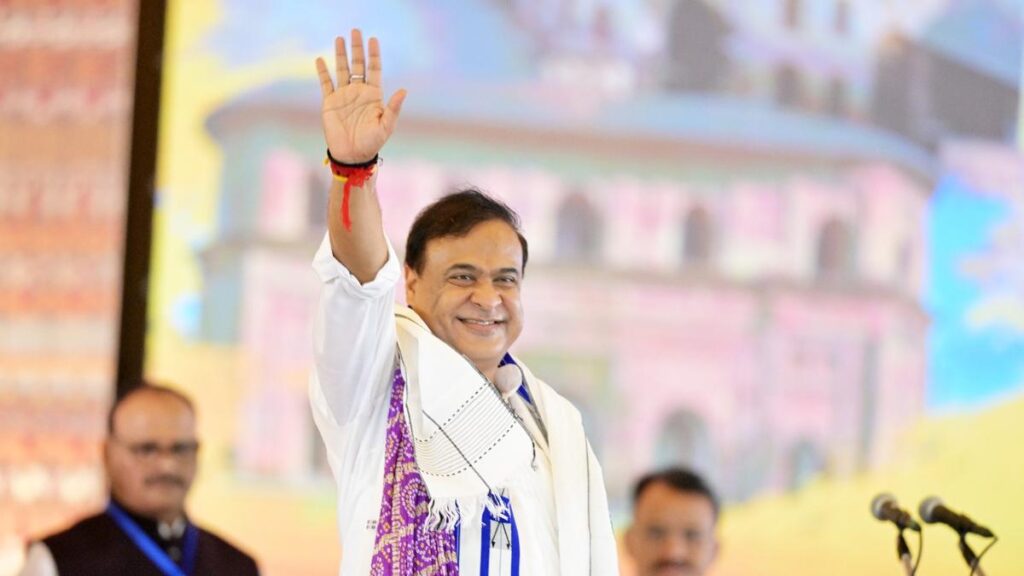
Chief Minister Himanta Biswa Sarma has repeatedly highlighted these changes, warning that indigenous Assamese people risk becoming a minority if trends continue unchecked.
The government has focused on border fencing, “Detect-Delete-Deport” policies, and economic development to balance growth with identity preservation.
Government Actions to Balance Demographic Change Under BJP Rule (2016–2026)
Since the Bharatiya Janata Party (BJP) came to power in Assam in 2016, first under Chief Minister Sarbananda Sonowal and then under Himanta Biswa Sarma (from 2021 onwards), the government has made addressing illegal immigration and demographic imbalance a central policy priority.
The administration has adopted a multi-pronged strategy combining detection, deportation, legal reforms, border security, and cultural protection while simultaneously pursuing aggressive economic development.
Key Initiatives and Achievements (2016–2026)
- Pushback Policy & Deportations: The government has aggressively implemented “pushback” operations using the Immigrants (Expulsion from Assam) Act, 1950. By early 2026, the state had reportedly pushed back thousands of alleged illegal immigrants. CM Himanta Biswa Sarma announced plans to deport 10,000–15,000 foreigners annually without waiting for a formal repatriation treaty with Bangladesh. In 2025 alone, hundreds were expelled, with continued operations into 2026.
- Border Fencing and Security: Near-completion of India-Bangladesh border fencing in Assam (over 228 km of barbed wire fencing completed). The government has pushed for better coordination with neighbouring states like West Bengal for seamless border management and strengthened the Comprehensive Integrated Border Management System.
- National Register of Citizens (NRC) and Foreigners Tribunals: Completion of the 2019 NRC exercise (though final implementation remains contested). Strengthening of Foreigners Tribunals and directives to expedite cases. The government has empowered District Commissioners for faster detection and action.
- Citizenship Amendment Act (CAA) Implementation: Fast-tracked citizenship for non-Muslim migrants from Bangladesh, Pakistan, and Afghanistan who entered before December 31, 2014. This includes withdrawing “foreigner” cases against eligible non-Muslim communities, aiming to protect persecuted minorities while differentiating them from alleged illegal Muslim immigrants.
- Land Protection and Anti-Encroachment Drives: Massive eviction drives against alleged illegal encroachments. Over 1.26 lakh hectares of land reportedly cleared. New laws and regulations to prevent land transfers in sensitive and indigenous areas. Protection of sites linked to Assamese heritage (e.g., Srimanta Sankardeva’s birthplace).
- Uniform Civil Code (UCC): In May 2026, the newly sworn-in cabinet cleared the draft Uniform Civil Code Bill, aimed at promoting social uniformity and indirectly addressing differential fertility and personal laws.
- Political and Administrative Measures:
- Strong public rhetoric by CM Himanta Biswa Sarma warning about demographic “takeover” and projecting Muslim population (especially Bangladeshi-origin) reaching 40% by 2027 and nearing 50% by 2041.
- Emphasis on “Detect-Delete-Deport” policy.
- Promotion of indigenous rights, language, and culture.
- Population stabilization efforts through education and women empowerment schemes.
Dual Approach: Security + Development
While cracking down on illegal immigration, the BJP government has simultaneously focused on rapid economic growth — positioning Assam as the economic engine of the Northeast — to reduce the pull factors of migration and create opportunities for indigenous youth. T
his includes massive infrastructure push, investment summits (Advantage Assam), skilling programs, and rural entrepreneurship schemes.Critics argue that some measures are selective and polarising, while supporters credit the government with finally showing political will on an issue neglected for decades.
The government maintains that protecting the demographic and cultural identity of indigenous Assamese people is essential for long-term peace and development in the state.This balancing act — combining hard security measures with inclusive economic policies — remains the defining feature of BJP rule in Assam since 2016.
Implications as a Case Study
Assam demonstrates how demography shapes destiny. The state’s experience highlights:
- Tension between economic opportunities (migrant labour in agriculture and informal sectors) and cultural preservation.
- Challenges of managing porous borders in a diverse, multi-ethnic region.
- The intersection of migration, fertility, and politics in shaping electoral outcomes and policy priorities.
While diversity brings vibrancy, rapid shifts can strain social cohesion, land resources, and political representation. Assam’s ongoing efforts — through legal, administrative, and developmental interventions — offer valuable lessons for other Indian states facing similar pressures.
Conclusion: Assam’s demographic journey from 1947 to 2026 underscores the need for balanced, evidence-based policies that protect indigenous rights while ensuring inclusive growth. Sustained monitoring, strict border management, and focused development in education and family planning will be critical to maintaining harmony in this strategically vital state of North East India.
This analysis is based on official Census of India data, government reports, and credible demographic studies.

Comments