
TECHNOCRAT MAGAZINE | YTC Ventures | www.ytcventures.com | 18 Sept 2026
Varthur–Gunjur’s latest traffic nightmare is no longer just about commuters losing time. With hundreds of schoolchildren trapped in buses for hours, Bengaluru’s infrastructure crisis is becoming a daily question of safety, education and quality of life.
There are few better ways to understand Bengaluru’s traffic crisis than through the journey of a child trying to get home from school.
On Thursday, a journey of just 4 kilometres on the Varthur–Gunjur stretch of State Highway 35 reportedly took as long as 2.5 hours.
For hundreds of schoolchildren, this was not an unusual evening spent in traffic. It came during the middle of school examinations, when punctuality mattered and fatigue had consequences.
School buses were delayed by as much as 40 minutes in the morning. Students reportedly reached examination halls anxious after being caught in congestion. By afternoon, the situation deteriorated further, with some children spending hours inside buses on the return journey.
The episode is being described as another Bengaluru traffic story.
But it is more than that.
It is a story about what happens when a rapidly expanding urban corridor grows faster than the roads, junctions, public transport systems and traffic-management infrastructure designed to serve it.
And this time, the people paying the price were schoolchildren.
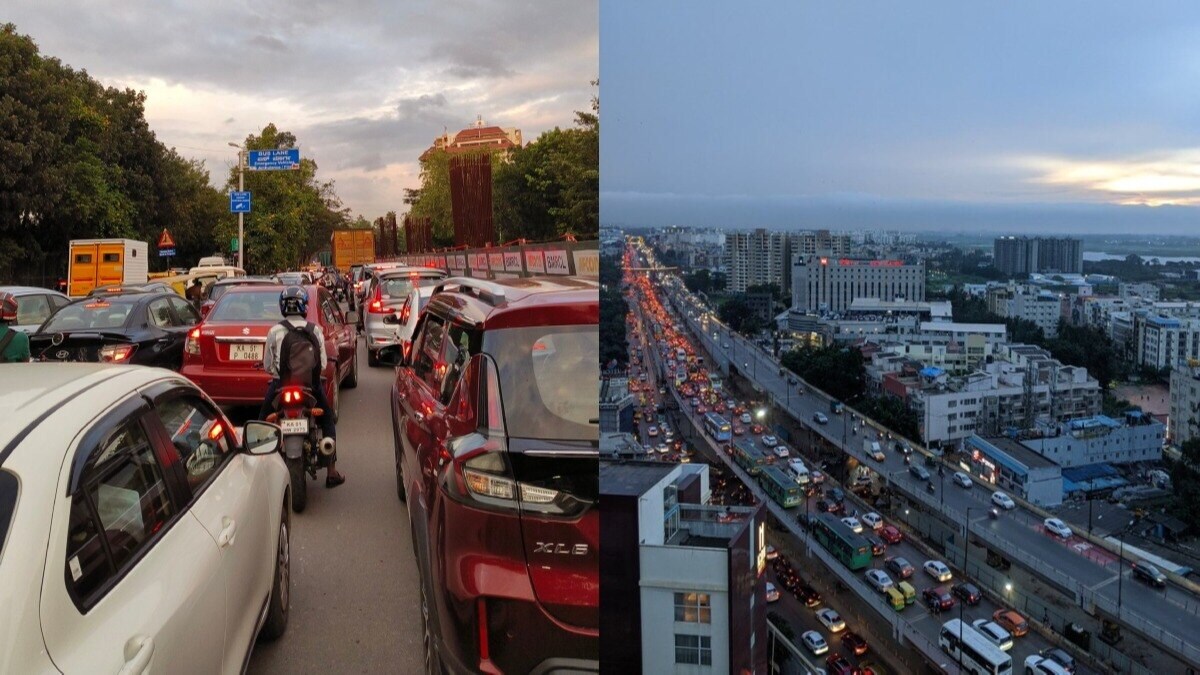
4 Kilometres. 2.5 Hours.
The numbers are difficult to comprehend.
A distance that would ordinarily be covered in minutes became a journey lasting hours.
The Varthur–Gunjur corridor has become one of the rapidly developing parts of east Bengaluru, surrounded by residential communities, schools, offices and construction activity.
The problem is that the road network has struggled to keep pace with that growth.
According to The Times of India, the corridor has 18–20 large schools, many of which were conducting mid-term examinations when the traffic crisis intensified.
That makes the consequences considerably more serious than an ordinary commuter delay.
A software engineer arriving 90 minutes late for work is frustrated.
A child arriving late for an examination faces an entirely different kind of pressure.
When the School Bus Becomes a Waiting Room
For many families in the Varthur–Gunjur area, the school bus is supposed to provide something simple: a predictable journey between home and school.
Instead, parents are increasingly having to calculate journeys in hours rather than kilometres.
Residents told TOI that children have been spending extraordinarily long periods in buses because of congestion and road conditions. One parent said her son, whose school is less than 2 kilometres from home, had recently been reaching home around 4:30pm despite school ending at 2:45pm.
Another resident reportedly abandoned the school-bus journey and attempted to take her child home on a two-wheeler after waiting around 45 minutes.
Even that did not solve the problem.
The journey reportedly took more than an hour for barely a kilometre.
That is the paradox of Bengaluru’s traffic crisis: sometimes changing the vehicle does not change the journey.
The bottleneck is the road itself.
The Infrastructure Problem Behind the Traffic
The Varthur–Gunjur road is undergoing infrastructure work being executed by the Karnataka Road Development Corporation.
But construction is only one part of the problem.
Residents have reported bottlenecks, damaged road surfaces, large craters and traffic that is poorly managed during peak periods.
Other reports have highlighted the combination of roadworks, poor surfaces and congestion as key contributors to the disruption. Parents in the wider Whitefield–Varthur–Gunjur corridor have also sought urgent road repairs and improved traffic management.
This creates a familiar Bengaluru cycle:
Development → more residents → more vehicles → greater congestion → road expansion → construction → temporary disruption → more development.
If the supporting infrastructure does not arrive at the same pace as population and commercial growth, congestion becomes structural rather than temporary.
And structural congestion cannot be solved simply by putting more traffic police at one junction.
Bengaluru’s Growth Has Changed the Geography of the City
Bengaluru’s traffic problem is often discussed as though it were concentrated around a few famous IT corridors.
But the city’s growth has changed the map.
Residential development has expanded deep into the eastern and southeastern parts of the metropolitan region.
Varthur, Gunjur, Balagere and surrounding areas have experienced significant development, bringing large residential communities into locations where road infrastructure has historically been less capable of handling metropolitan-scale traffic.
Schools have followed families.
Commercial establishments have followed residents.
Private vehicles have followed both.
The result is a road network carrying multiple types of traffic simultaneously:
- School buses
- Two-wheelers
- Cars
- Delivery vehicles
- Heavy commercial vehicles
- Construction vehicles
- Public transport
- Pedestrians
When these movements converge on a limited road corridor, even a relatively small disruption can trigger a traffic cascade.
The School-Exam Problem
Thursday’s congestion was particularly damaging because it coincided with examinations.
Parents told TOI that children arrived at examination halls anxious after their buses were delayed. Some schools reportedly provided additional time to students affected by the traffic.
That response may help individual students.
But it does not solve the underlying problem.
A school examination operates according to a timetable.
Traffic does not.
That creates an uncomfortable inequality.
Children whose families live close to functioning roads may arrive on time.
Children whose school buses must cross a badly congested corridor can lose significant time before the examination even begins.
The academic consequences may be temporary.
The anxiety is immediate.
The Hidden Cost of Traffic
Bengaluru’s traffic is usually measured in familiar units:
kilometres.
minutes.
average speed.
vehicle counts.
But those numbers do not fully capture the human cost.
Consider what happens inside a school bus trapped for two hours.
Children cannot simply get out and walk home.
They cannot choose another route.
They cannot control the traffic.
They are dependent on the driver, the road and the traffic-management system.
A two-hour delay can mean:
- missed study time;
- missed tuition;
- delayed meals;
- exhaustion;
- parental anxiety;
- disrupted family schedules;
- increased exposure to dust and roadside pollution;
- greater risk when parents resort to two-wheelers to avoid buses.
That makes school transport an important measure of urban infrastructure.
If a child cannot reliably travel a few kilometres to school, the city has a mobility problem that goes beyond inconvenience.
The Heavy-Vehicle Question
Residents have also raised concerns about heavy vehicles moving through the corridor during school hours.
This is an important traffic-management issue.
Urban roads are not simply pieces of asphalt. Their performance depends on when different categories of vehicles use them.
A heavy truck, a school bus and hundreds of two-wheelers do not have the same effect on traffic flow.
Where road capacity is already constrained by construction or damaged surfaces, the timing of heavy-vehicle movement can become particularly important.
The solution therefore may not be only about building more road.
It may involve asking a more basic question:
Who should be allowed to use a particular corridor, and when?
Bengaluru Cannot Build Its Way Out of Every Traffic Jam
The instinctive response to congestion is often to build.
Widen the road.
Build a flyover.
Add another lane.
Construct an underpass.
Create another connection.
Infrastructure is unquestionably important. But Bengaluru’s experience demonstrates that road construction alone cannot guarantee free-flowing traffic.
Every new road can generate additional demand.
Every new residential development adds trips.
Every new school adds school buses and parent vehicles.
Every commercial hub adds workers and deliveries.
The challenge is therefore not merely road capacity.
It is urban mobility planning.
Where people live.
Where they work.
Where schools are located.
How children travel.
Where buses stop.
When trucks move.
How junctions operate.
And whether public transport provides a realistic alternative to private vehicles.
The Two-Wheeler Trap
When school buses fail, parents often look for alternatives.
In Bengaluru, the most obvious alternative for short distances is the two-wheeler.
But this can create another problem.
Parents transporting children on motorcycles or scooters must navigate exactly the same potholes, bottlenecks, construction zones and unpredictable traffic that trapped the school buses.
The difference is that a school bus surrounds a child with a larger vehicle.
A two-wheeler does not.
Residents have therefore expressed concerns about putting children on two-wheelers amid deteriorating road conditions and accident risks.
This creates a troubling mobility trade-off:
Stay in the traffic jam—or take a potentially more vulnerable mode of transport to escape it.
That should not be the choice facing families.
Varthur–Gunjur Is a Warning for Bengaluru
The Varthur–Gunjur crisis should not be treated as an isolated traffic story.
It is a warning about what happens when urban expansion and transportation infrastructure move at different speeds.
The corridor already contains major residential development and a significant concentration of schools.
If infrastructure construction temporarily reduces road capacity while demand continues rising, the system becomes extremely sensitive to disruption.
One blocked junction can affect kilometres of traffic.
One poorly managed construction zone can delay thousands of commuters.
One school-bus bottleneck can create a chain reaction across the road network.
And when that happens during school hours, children become some of the most vulnerable people in the system.
What Could Make the Corridor More Predictable?
The immediate response does not necessarily have to wait for every infrastructure project to be completed.
Several measures can potentially reduce disruption if implemented through coordinated traffic and civic planning:
1. School-hour traffic management
Traffic-management plans should specifically account for the arrival and departure times of the 18–20 major schools in the corridor.
2. Heavy-vehicle scheduling
Where feasible, authorities could examine whether certain heavy vehicles can be restricted or rescheduled during peak school-commute periods.
3. Construction coordination
Road construction needs to be coordinated so that one infrastructure project does not create avoidable bottlenecks elsewhere.
4. School-bus priority
Designated stopping points and managed school-bus movement could reduce conflicts with general traffic.
5. Junction-level intervention
Sometimes the problem is not the entire road but a handful of critical intersections where traffic merges, turns or narrows.
6. Real-time traffic communication
Parents need reliable information when severe congestion occurs.
If a school bus is going to be delayed by 90 minutes, families should know early rather than waiting without information.
7. Safe pedestrian infrastructure
Children should not have to negotiate construction zones or damaged road edges simply to reach school transport.
The Bigger Bengaluru Question
Bengaluru has become one of India’s most important economic centres.
But economic growth creates a responsibility beyond attracting companies and building homes.
A city has to make everyday life work.
People need to be able to:
go to school,
go to work,
reach hospitals,
deliver goods,
use public transport,
walk safely,
and return home within a predictable period of time.
That is the basic infrastructure contract between a city and its residents.
When a 4-kilometre school journey takes 2.5 hours, that contract is under strain.
A City Measured in Lost Hours
The most revealing image from the Varthur–Gunjur traffic crisis is not the kilometre-long line of vehicles.
It is the child sitting inside a school bus, watching the clock.
An examination is waiting.
A parent is waiting at home.
The driver is waiting for the traffic to move.
And the city is waiting for its infrastructure to catch up with its growth.
For Bengaluru’s technology economy, traffic congestion has long been described as a productivity problem.
For families, it is increasingly something more personal.
It is time taken away from children.
It is anxiety for parents.
It is uncertainty built into every school day.
And when four kilometres can consume two and a half hours, the question Bengaluru faces is no longer simply:
“How do we reduce traffic?”
It is:
“What kind of city makes a child spend hours travelling a few kilometres to school?”
The answer will not come from one flyover, one road-widening project or one traffic diversion.
It will require Bengaluru to think about mobility as a complete urban system—one in which roads, schools, public transport, construction, housing and traffic management are planned together.
Until that happens, the traffic jam will remain more than an inconvenience.
It will remain a daily tax on the city’s time—and, increasingly, on its children.

Comments