
YTC Ventures | TECHNOCART MAGAZINE | www.ytcventures.com
16 MAY 2026
The New Gold Rush of Influence — Why Trump’s China Visit Signals the Dawn of Technocratic Realism
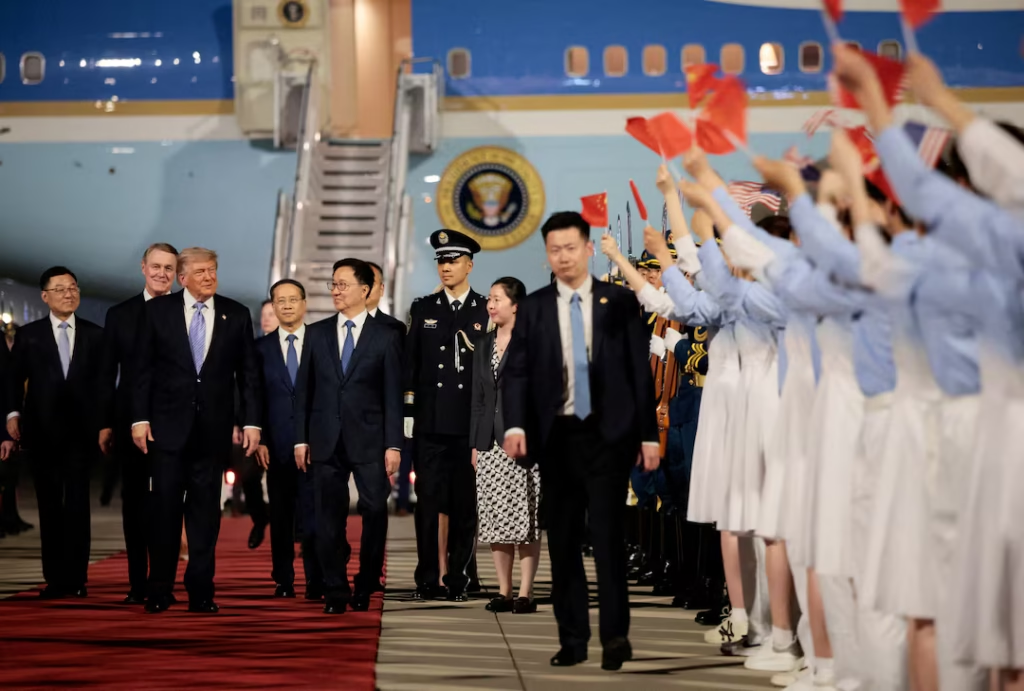
In May 2026, President Donald J. Trump made a high-stakes two-day state visit to Beijing (May 13–15), marking his second state visit to China.
Amid global tensions over Iran, the Strait of Hormuz disruptions, and ongoing trade frictions, the summit with President Xi Jinping blended imperial pageantry with hard-edged business pragmatism.While critics called it “big on ceremony, light on substance,” the real story lies deeper: a masterclass in transactional diplomacy where American technocratic power met Chinese strategic patience.
Key Delegation: Who Was on Air Force One?
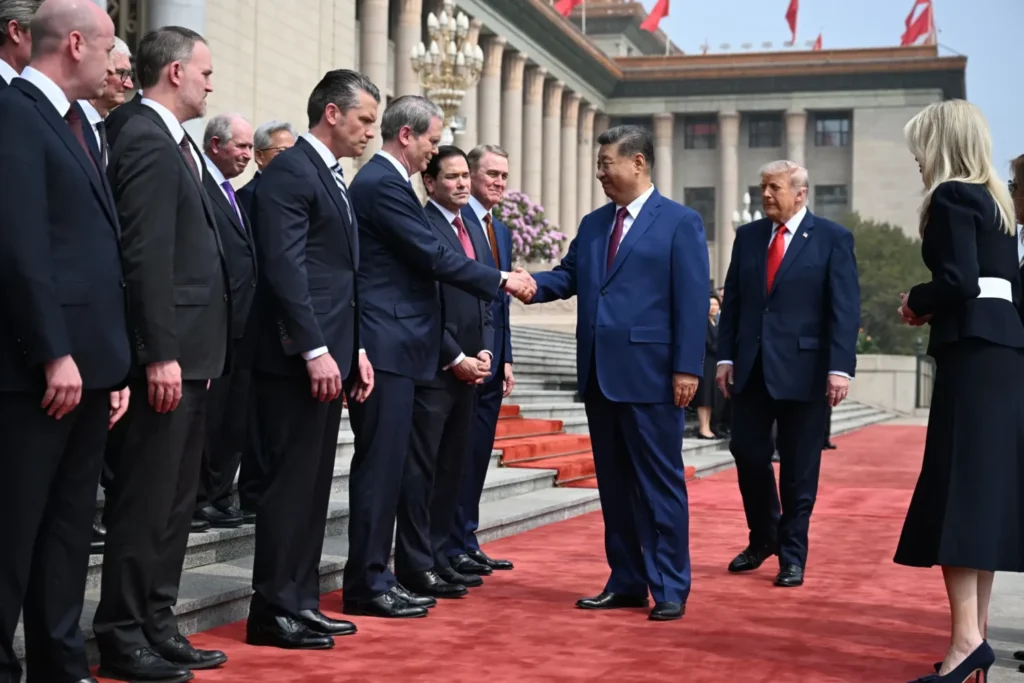
Trump did not travel light. He brought a powerful mix of Cabinet heavyweights and America’s top corporate titans — a clear signal that this was as much a business mission as a diplomatic one.Top Delegation Table:
| Category | Key Individuals | Role / Significance |
|---|---|---|
| Cabinet Officials | Marco Rubio (Secretary of State) Scott Bessent (Treasury Secretary) Pete Hegseth (Defense Secretary) | Hardline China policy architects |
| Senior Advisors | Stephen Miller (Deputy Chief of Staff) | Immigration & economic nationalism |
| Tech & Industry Titans | Elon Musk (Tesla, SpaceX) Tim Cook (Apple) Jensen Huang (Nvidia) | AI, semiconductors, EVs, supply chains |
| Finance & Investment | Larry Fink (BlackRock) David Solomon (Goldman Sachs) Jane Fraser (Citi) Stephen Schwarzman (Blackstone) | Capital flows & investment access |
| Aerospace & Others | Kelly Ortberg (Boeing) Executives from Meta, Cargill, Visa, Qualcomm, Micron | Trade deals in aviation, agriculture, tech |
This delegation represented trillions in market capitalization and gave Trump direct leverage in closed-door negotiations.
The Agenda: What Was Really Discussed
The summit agenda was broad and calculated:
- Trade & Economic Rebalancing — Extension of tariff truces, increased U.S. agricultural purchases, and energy deals.
- Aviation & Big-Ticket Purchases — Boeing aircraft orders.
- Critical Minerals & Supply Chains — Rare earths, semiconductors, and AI cooperation frameworks.
- Geopolitical Flashpoints — Iran, Strait of Hormuz stability, Taiwan, fentanyl precursors, and nuclear issues.
- Investment & Market Access — Creation of bilateral “Board of Trade” and “Board of Investment” mechanisms.
Trump described the meetings as “incredible” and claimed “fantastic trade deals” for both nations. Xi emphasized “constructive and strategic partnership.”
Major Outcomes
- Boeing Deal: China committed to purchasing 200 Boeing jets, with Trump hinting at potential follow-on orders up to 750 planes.
- Agriculture & Energy: Expected increases in U.S. soybean, LNG, and other agricultural/energy purchases.
- Institutional Mechanisms: Agreement to establish formal bilateral boards for trade and investment oversight.
- Geopolitical Alignment: Broad discussions on Iran and Hormuz disruptions, with both sides expressing desire to avoid escalation.
- No Major Breakthroughs on Structural Issues: Limited progress on technology transfer, intellectual property, or deep market reforms in China. Taiwan remained a sensitive red line.
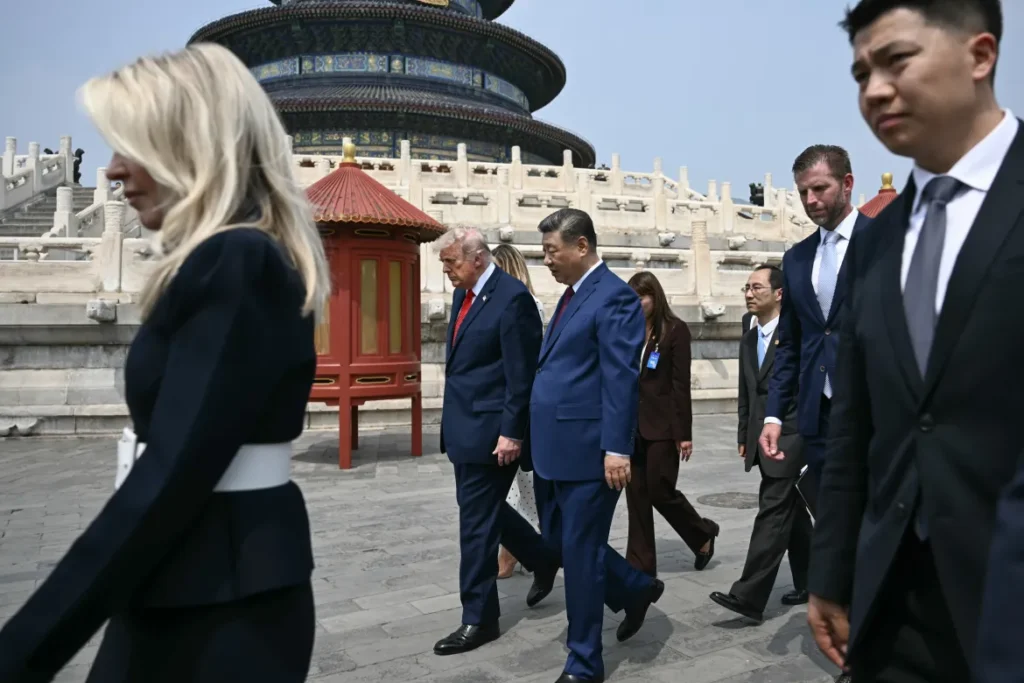
The trip was heavy on symbolism (Temple of Heaven visit, grand state banquet) but delivered modest, transactional wins — typical of Trump’s deal-making style.
Global Business Implications: The Technocratic Realignment
This summit underscores a new reality in 2026: Technocrats and corporate leaders are now co-pilots in great-power diplomacy.By bringing Musk, Cook, Huang, and Fink, Trump weaponized American corporate power. The message was clear — access to the Chinese market is still valuable, but only on terms that protect U.S. strategic interests.For global business, the implications are profound:
- Supply Chain Pragmatism — Companies are doubling down on “China +1” strategies while keeping selective deep engagement.
- AI & Semiconductor Race — Nvidia and others are navigating export controls while pushing for measured cooperation.
- Capital Reallocation — BlackRock, Blackstone, and Goldman types are positioning for selective investment windows if tariff stability holds.
- Aviation & Commodities Boom — Boeing’s win boosts U.S. manufacturing and reinforces America’s leverage in high-value exports.
The visit also highlights the return of transactional bilateralism over multilateral idealism. In a fragmenting world order, personal rapport between Trump and Xi, backed by powerful CEOs, may deliver more immediate results than endless WTO negotiations.
The Cold Technocratic View
For the new global elite, Trump’s China visit was neither victory nor defeat — it was positioning.Trump secured visible wins (Boeing orders, purchase commitments) to claim domestic success. Xi bought time and stability for China’s economy while reinforcing red lines on Taiwan and core interests.
The real winners may be the corporations that now have higher-level access and clearer (if still limited) playing rules.This summit did not reset U.S.-China relations. It stabilized them at a higher level of managed competition — exactly what technocrats prefer: predictability for capital deployment, while great-power rivalry continues in technology, military, and influence domains.
The era of naive globalization is over.
The era of calculated, ruthless pragmatism has begun.In this new game, those who master both the boardroom and the geopolitical chessboard will dominate the 21st century.

Comments