
YTC Ventures | TECHNOCRAT MAGAZINE | www.ytcventures.com
15 April 2026
Noida’s industrial hub erupted in chaos on April 13-14, 2026, as nearly 40,000 to 45,000 factory workers staged a massive protest demanding higher wages, better working conditions, and fixed duty hours.
What began as peaceful sit-ins quickly turned violent with stone-pelting, arson, and vandalism, forcing police to use tear gas and minimum force.
The unrest spread across 80+ locations in Gautam Buddh Nagar, including key industrial clusters, bringing traffic to a standstill and raising serious concerns about law and order in one of India’s largest manufacturing zones.
Analysis of the Noida Employee Revolt Development
This revolt highlights deep-rooted frustrations among Noida’s blue-collar workforce. Workers, many earning just ₹13,000–₹20,000 per month for 8–12 hour shifts, cited soaring living costs — especially cooking gas and fuel prices triggered by global disruptions. Demands included a significant minimum wage hike, overtime pay, and improved safety standards.
The Uttar Pradesh government responded swiftly by announcing a 21% interim wage revision (effective retrospectively from April 1, 2026). While this was aimed at calming tensions, many workers rejected it as “inadequate,” leading to continued protests on Day 2 (April 14).
Police have lodged multiple cases and arrested around 400 people. Authorities are also probing whether external elements hijacked the otherwise legitimate wage agitation.
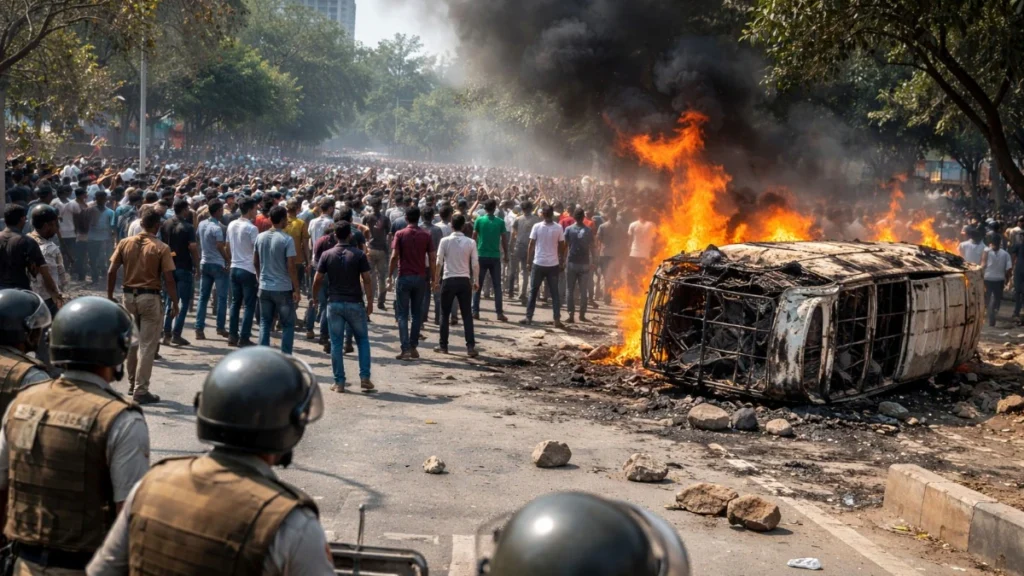
The scale (40,000+ workers across 80+ sites) shows coordinated mobilisation but also exposed vulnerabilities in industrial relations in the NCR.
Broader implications:
- It signals a growing affordability crisis for low-wage workers amid inflation.
- Factories fear long-term insecurity, with some associations warning of safety risks for industries.
- It puts pressure on policymakers to balance worker rights with industrial growth in Uttar Pradesh.
The unrest has disrupted production in Noida’s manufacturing belt, affecting supply chains and sending a strong message that worker discontent can no longer be ignored.
Which Factories and Businesses Are Involved?
The protests were not limited to a single company but involved workers from multiple factories across Noida’s industrial clusters.
Most participants were from manufacturing units in sectors like auto components, hosiery, handloom/handicrafts, and general factory work.
Prominently mentioned businesses/units:
- Motherson (Phase-2) — Workers allegedly climbed factory walls and cut fencing here, triggering early violence.
- Guru Amardass International Pvt. Ltd. (Sector 80) — Protest turned violent with stone-pelting that damaged the factory facade.
- Handloom & Handicraft units in Sectors 63, Phase-1, and Phase-2 — Multiple factories reported attacks on gates, glass panes, and premises.
- General factory workers from industrial areas in Sector 60, Sector 62, Sector 84, and parts of Greater Noida.
The movement was largely organic among contract and daily-wage workers across these zones.
List of Business Buildings & Properties Stone-Pelted
Violence was concentrated in industrial areas.
Here is a clear list of reported locations where business buildings, factories, or related properties faced stone-pelting, vandalism, or arson:
- Phase-2 Industrial Area (major hotspot): Multiple factory buildings, including Motherson unit; factory gates broken, walls pelted, vehicles torched.
- Sector 60: Factory premises and nearby properties vandalised with stones.
- Sector 80: Guru Amardass International Pvt. Ltd. factory facade heavily damaged by stones.
- Sector 63: Several industrial units (handloom/handicraft exporters) reported stone-pelting on gates and glass panes.
- Phase-1 Industrial Units: Factories attacked; vehicles and property damaged.
- Sector 121 (Cleo County area): Stone-pelting reported outside the housing society (adjacent to protest route).
Additionally, random vehicles and at least one car showroom were set on fire during the chaos.Current Status (as of April 15, 2026): Police presence remains heavy.
Most workers have returned after the wage announcement, but tensions linger in some pockets. Authorities urge calm and dialogue.
Current Status of Employment in India: Latest Statistics (February 2026)
The Noida unrest occurs against the backdrop of India’s improving yet fragile labour market.
According to the latest Periodic Labour Force Survey (PLFS) Monthly Bulletin released by the Ministry of Statistics and Programme Implementation (MoSPI), India’s employment indicators show stability with marginal gains in February 2026.
| Indicator | February 2026 Value | Change from January 2026 |
|---|---|---|
| Labour Force Participation Rate (LFPR, 15+ years) | 55.9% | Stable (unchanged) |
| Worker Population Ratio (WPR / Employment Rate, 15+ years) | 53.2% | Slight increase from 53.1% |
| Overall Unemployment Rate (UR, 15+ years) | 4.9% | Down from 5.0% |
| Rural Unemployment Rate | 4.2% | Stable |
| Urban Unemployment Rate | 6.6% | Down from 7.0% |
| Female Unemployment Rate | 5.1% | Down from 5.6% |
| Female LFPR (15+ years) | 35.3% | Up from 35.1% |
Total Employment: Approximately 574–580 million people were employed nationwide (based on recent quarterly trends).
This reflects steady job creation, particularly in manufacturing and services, though challenges persist in formal sector absorption and youth employment.
Future Outlook for Jobs in India
India’s job market in 2026 and beyond looks cautiously optimistic, driven by skill-led hiring, digital transformation, and policy support.
Key trends include:
- Steady hiring growth: Around 1.28 crore new job opportunities projected in 2026, with strong demand in IT, GCCs (adding 5 lakh+ positions), manufacturing (under PLI schemes), and services.
- Gig economy & AI boom: Rise in freelancing, remote work, and AI-supplemented roles; employability rate has climbed to 56.35% in 2026.
- Focus on skilling: Employers prioritising AI, cybersecurity, cloud computing, and digital skills; freshers hiring intent remains high (73% of companies plan to onboard first-time job seekers in H1 2026).
- Challenges ahead: Youth unemployment (15–29 years) remains elevated at around 10%, informal employment is still dominant, and automation may displace routine jobs. Gender gaps and the need for formal wage jobs continue to be pain points.
Overall, India is poised for quality job creation if skilling, infrastructure, and inclusive policies accelerate. The Noida revolt underscores the urgency: sustained wage growth and better working conditions will be critical to harness the demographic dividend and prevent future unrest.
This Noida employee revolt serves as a wake-up call for industries and the government alike. While the wage hike is a positive step, sustainable solutions — fair wages, better living conditions, and transparent communication — are essential to prevent future unrest in India’s industrial heartland.All the best to workers and industries — may peace and productivity return soon.

Comments