
YTC Ventures | TECHNOCRAT MAGAZINE | www.ytcventures.com
10 Jan 2026
In the crisp winter skies of early January 2026, a colossal shadow has captured the imagination of aviation watchers and national security buffs alike. The Boeing E-4B Nightwatch—infamously known as the “Doomsday Plane”—made headlines with its unusual cross-country jaunt.
Spotted departing from Offutt Air Force Base in Nebraska on January 6, it touched down at Joint Base Andrews near Washington, DC, before making a historic landing at Los Angeles International Airport (LAX) on January 8. For a machine designed to survive the apocalypse, this public display feels almost theatrical, fueling online buzz and whispers of heightened global alerts.But what exactly is this airborne behemoth, and why does it evoke images of Cold War paranoia in our modern era?

As tensions simmer in hotspots like Venezuela and beyond, the E-4B’s rare visibility serves as a stark reminder of America’s unyielding nuclear posture.
Let’s dive into the story behind the “Flying Pentagon” and explore the broader arsenal that keeps the U.S. at the pinnacle of global power.
A Fortress in the Sky: Decoding the Doomsday Plane
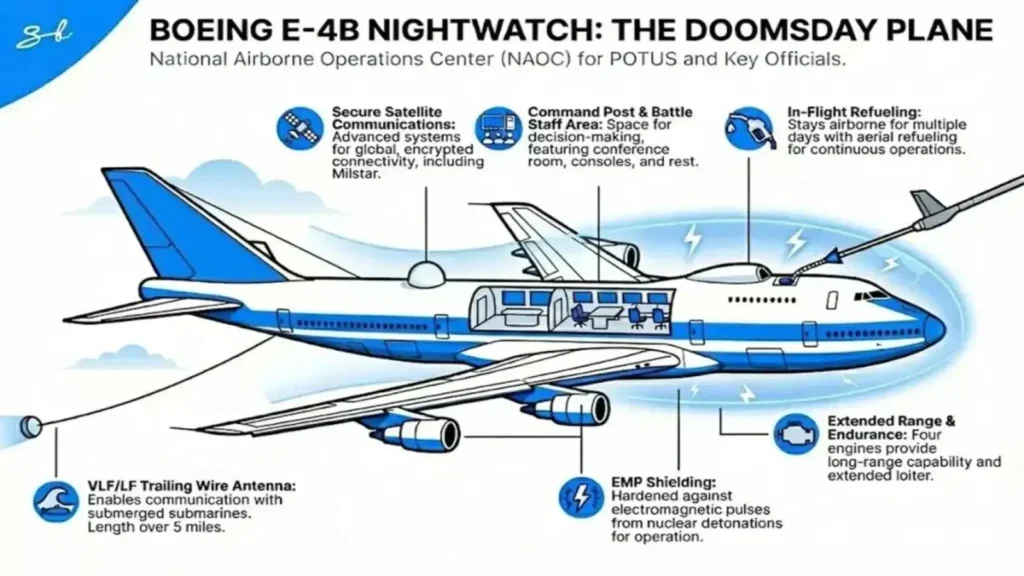
Imagine a modified Boeing 747 transformed into an indestructible command hub, capable of directing the nation’s defenses from 30,000 feet. That’s the E-4B Nightwatch in a nutshell. Nicknamed the “Flying Pentagon” for its ability to mirror the functions of the actual Pentagon during existential crises, this aircraft is engineered for the unthinkable: nuclear war, electromagnetic pulses, or any catastrophe that could cripple ground operations.At its core, the E-4B is the National Airborne Operations Center (NAOC), a mobile nerve center for top brass including the President and Secretary of Defense. Its specs read like a sci-fi thriller:
- Bulletproof Design: Shielded against nuclear blasts, radiation, and EMPs, with hardened electronics to keep systems humming.
- Endless Flight: Capable of 12 hours aloft unrefueled, or indefinitely with mid-air top-ups—one record flight clocked over 35 hours.
- War Room on Wings: Packed with satellite gear, antennas, briefing suites, and secure lines to command nuclear subs, bombers, and missiles. It can house up to 112 personnel, ensuring government continuity no matter the chaos below.
These features make it more than just a plane; it’s a symbol of resilience. With four such aircraft in the fleet—one always on 24/7 alert—the E-4B ensures that even if the world ends, America’s leadership endures.
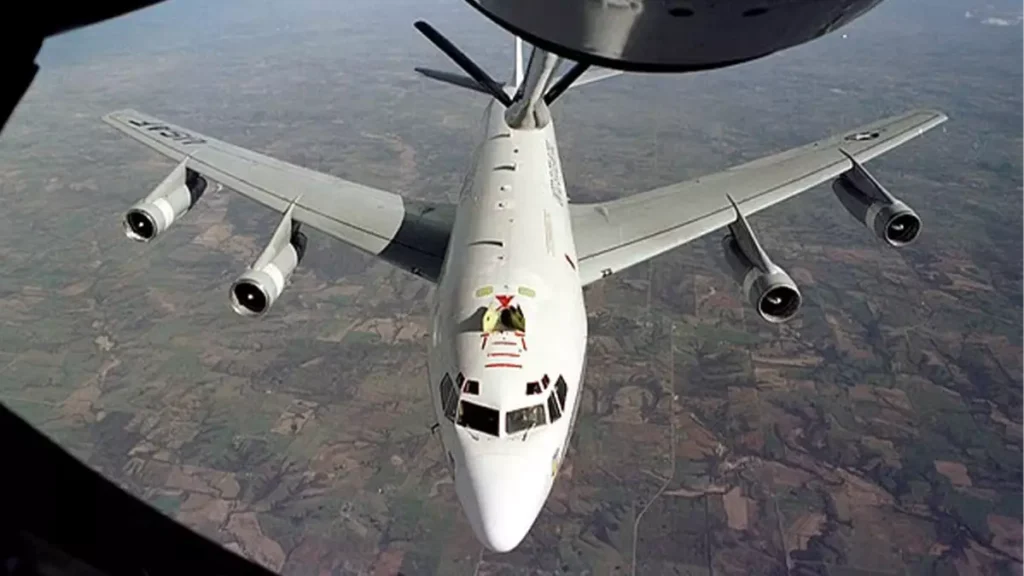
Spotlight on Sightings: Routine or Red Flag?
The January flights weren’t shrouded in total secrecy. Defense Secretary Pete Hegseth was reportedly aboard for segments of the journey, adding a layer of intrigue. The Pentagon downplays it as standard procedure: training drills, equipment tests, and readiness checks. Yet, in a year marked by U.S. interventions abroad and geopolitical chess games, the LAX touchdown—possibly the first at a major civilian hub in the plane’s 51-year history—has ignited speculation.
Social media erupted with theories, from doomsday preps to symbolic shows of force. Experts, however, urge calm: These birds fly regularly to stay sharp. Still, in an uncertain world, their presence overhead is a quiet flex of U.S. might.
America’s Nuclear Arsenal: The Ultimate Deterrent
Beneath the drama of the Doomsday Plane lies the real muscle: the U.S. nuclear triad, a three-pronged system of land, sea, and air-based weapons designed for mutually assured destruction. As of early 2026, the U.S. maintains an estimated stockpile of around 3,700 warheads, with about 1,770 deployed and ready. This arsenal isn’t just for show—it’s the backbone of global deterrence.
Here’s a breakdown of key U.S. nuclear capabilities:
| Category | Weapon System | Quantity | Key Features |
|---|---|---|---|
| Intercontinental Ballistic Missiles (ICBMs) | Minuteman III (upgrading to Sentinel) | 400 missiles | Land-based, silo-launched; each carries 1-3 warheads; range over 6,000 miles; part of a $140 billion modernization push. |
| Submarine-Launched Ballistic Missiles (SLBMs) | Trident II D5 | Up to 280 missiles across 14 Ohio-class submarines | Sea-based stealth; each missile holds up to 8 warheads; virtually undetectable, ensuring second-strike capability. |
| Strategic Bombers | B-52H Stratofortress, B-2 Spirit (B-21 Raider incoming) | About 60 bombers | Air-delivered gravity bombs (B61, B83) and cruise missiles (ALCM); flexible for both nuclear and conventional roles. |
| Tactical/Non-Strategic Weapons | B61 Gravity Bombs (various mods) | Several hundred | Deployed in Europe under NATO sharing; lower yield for battlefield use. |
| Total Warheads | Stockpile: ~3,700 (Deployed: ~1,770) | N/A | Includes reserves and retired warheads awaiting dismantlement (~1,800). |
This triad guarantees no single attack can neutralize U.S. retaliation, preserving balance in a multipolar world facing rivals like Russia (5,459 warheads) and China.

The Price of Power: Funding the Nuclear Shield
Maintaining this edge doesn’t come cheap. For Fiscal Year 2026, the Department of Defense has allocated approximately $60 billion to the nuclear enterprise, covering everything from warhead upkeep to platform upgrades.
Over the next decade (2025–2034), projections peg the total cost at a staggering $946 billion—encompassing operations, modernization, and new builds like the Sentinel ICBM, whose price tag has ballooned to over $140 billion alone.These funds flow through the Department of Energy (for warheads) and DOD (for delivery systems), fueling innovations in hypersonics and stealth. Critics decry it as excessive in a post-Cold War era, but proponents argue it’s an investment in peace: deterrence on a budget that pales against full-scale war costs.

Winning Without Firing: The Strategic Edge of Nuclear Might
Nuclear weapons haven’t been used in combat since 1945, yet they’ve “won” countless conflicts by preventing them. The doctrine of deterrence—threatening overwhelming retaliation—has kept major powers from direct clashes for decades.
For the U.S., this arsenal underpins victories in subtler ways:
- Preventing Escalation: In wars like Korea, Vietnam, or recent proxy conflicts, nuclear shadows deterred foes from going all-in, allowing American conventional forces to dominate without apocalyptic risks.
- Alliance Leverage: Extended deterrence shields allies (e.g., NATO, Japan, South Korea), deterring aggression and enabling U.S. diplomatic wins without boots on the ground.
- Global Stability: By countering proliferation and arms races, U.S. nukes foster negotiated peace, as seen in treaties like the expiring New START with Russia.
- Psychological Warfare: The mere existence of capabilities like the E-4B signals resolve, influencing adversaries’ calculations and tipping scales in crises.

In essence, nukes don’t “win wars” through blasts but through fear of them—ensuring America’s strategic superiority in an era where full-scale victory means avoiding Armageddon altogether.As the Doomsday Plane returns to the shadows, it leaves us pondering: In a world of rising threats, is this flying fortress a relic or a necessity? One thing’s clear—America’s nuclear umbrella remains the ultimate backup plan, ready for whatever storms brew on the horizon.

Comments