
YTC Ventures | Technocrat’ Magazine | www.ytcventures.com
In a high-profile fusion of modern political influence and traditional high-society lineage, President Donald Trump announced the engagement of his eldest son, Donald Trump Jr., 47, to Palm Beach socialite and philanthropist Bettina Anderson, 38-39, at a White House holiday party on December 15, 2025.
The moment, shared widely through viral videos and social media, captures Donald Jr. expressing gratitude to Anderson for accepting his proposal, describing it as a “big win for the end of the year.” Anderson, radiant in a sparkling red gown, called the experience “unforgettable” and herself the “luckiest girl in the world,” while commending the elegant decorations overseen by First Lady Melania Trump.
The couple’s romance, which became public in late 2024 following Donald Jr.’s separation from former fiancée Kimberly Guilfoyle (now U.S. Ambassador to Greece), has accelerated swiftly.
Throughout 2025, they appeared together at marquee events, including the presidential inauguration, Super Bowl festivities, and exclusive gatherings at Mar-a-Lago, signaling a deepening integration into the Trump family’s inner circle.
Bettina Anderson: Roots in Palm Beach’s Established Elite
Born in December 1986, Anderson hails from one of Palm Beach’s storied families. Her father, the late Harry Loy Anderson Jr. (who passed in 2013 at age 70), made history as the youngest bank president in the U.S. at 26, leading Worth Avenue National Bank and building a legacy in Florida’s financial sector. Her mother, Inger Anderson, a Swedish immigrant and dedicated philanthropist, contributed significantly to community causes until her passing.
The family’s historic lakefront estate sold for $11.88 million following Inger’s death, underscoring their substantial real estate holdings in one of America’s most exclusive enclaves.A Columbia University graduate with a degree in art history, Anderson has carved her own path through modeling (appearing in Palm Beach Illustrated), banking roles, and philanthropy.
She founded The Paradise Fund (now Paradise.ngo), a nonprofit emphasizing environmental conservation, wildlife protection, disaster relief, and arts education in Florida. Her initiatives leverage data-driven approaches to ecosystem preservation and community resilience, aligning with emerging technocratic priorities in sustainable development.
While Anderson’s personal net worth is estimated at $500,000 to $600,000 (based on unverified reports from late 2025), her wealth is augmented by inherited family assets and a lifestyle reflective of old-money Palm Beach—private clubs, charitable boards, and high-society events.
She owns a West Palm Beach home purchased for $860,000, a modest but upscale property in the region’s context.
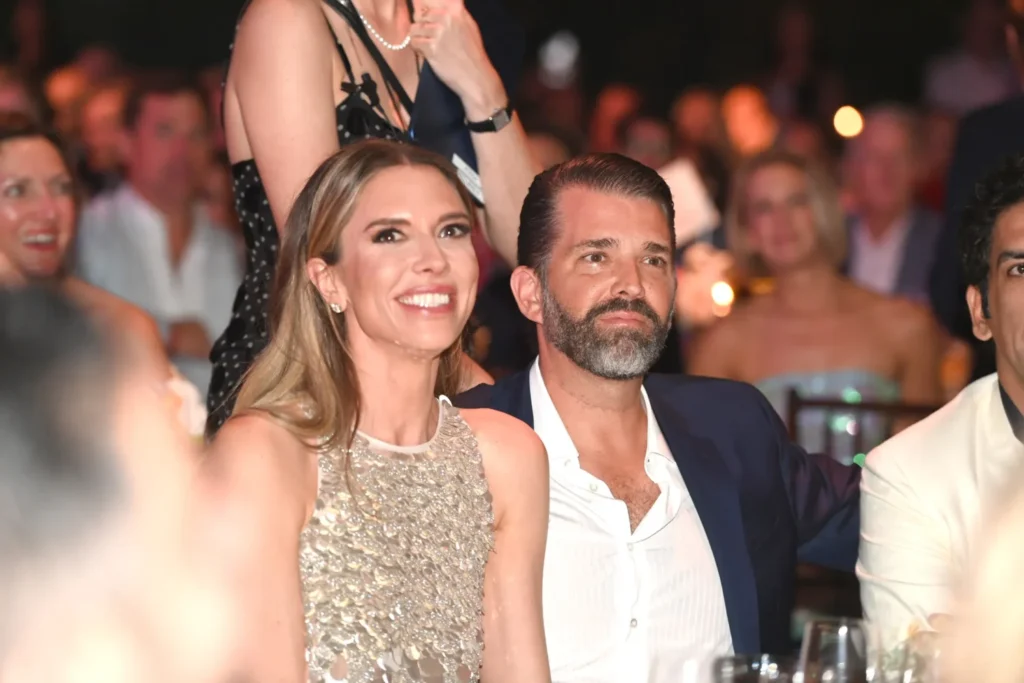
Donald Trump Jr.: From Family Empire to Crypto-Fueled Growth
Donald Trump Jr., a key figure in the Trump Organization and a prominent conservative voice through podcasts, books, and public speaking, brings substantial financial firepower to the union.
As of December 2025, Forbes estimates his net worth at approximately $300 million—a six-fold increase from about $50 million in late 2024, largely attributed to savvy investments in cryptocurrency ventures amid the sector’s boom.This growth reflects broader trends in the Trump family’s wealth trajectory.
Collective estimates place the extended Trump family (including the president, siblings, and in-laws like Jared Kushner) at around $10 billion in mid-2025, though fluctuations in crypto markets have introduced volatility, with recent reports noting dips to $6-7 billion ranges.
Donald Jr.’s stake in real estate, media ventures, and emerging tech assets positions him as a bridge between traditional business empires and digital innovation.
Technocratic Lens: Wealth Consolidation and Influence Amplification
This engagement exemplifies the strategic convergence of disparate elite networks in contemporary America. Palm Beach serves as a nexus for old-money philanthropists and nouveau political dynasties, where social capital translates into policy access.
Anderson’s expertise in nonprofit governance and environmental stewardship—fields increasingly reliant on data analytics, AI-driven modeling for climate risks, and public-private partnerships—complements Donald Jr.’s entrepreneurial pivot toward blockchain and decentralized finance.From a governance efficiency standpoint, such alliances enhance informal influence channels. In an era of complex challenges like coastal resilience (vital to Florida) and regulatory frameworks for emerging technologies, blended networks facilitate expert-led solutions: integrating philanthropic data with political leverage for optimized outcomes in resource allocation and innovation policy.
Moreover, the wealth disparity—Donald Jr.’s hundreds of millions versus Anderson’s more modest personal fortune rooted in generational assets—highlights evolving dynamics in elite marriages.
Old-money stability meets new-economy volatility, potentially stabilizing influence amid market swings.As wealth concentration and dynastic ties continue shaping U.S. leadership, this union signals a fortified power structure, blending tradition with disruption.
Congratulations to the couple on this pivotal chapter.

Comments