
YTC Ventures | Technocrat Magazine
October 18, 2025
In the heart of India’s Silicon Valley, where innovation drives the global tech agenda, a simple 7 km drive has become a harrowing symbol of urban despair. A Bengaluru resident’s viral Reddit post detailing his 1.5-hour traffic jam with his eight-month pregnant wife has ignited a firestorm, forcing the city’s elite—tech leaders, startups, and policymakers—to confront a brutal question: Is Bengaluru still liveable?
As the post racks up thousands of shares and comments, it underscores a deeper crisis: how unchecked urban growth is strangling the very ecosystem that made this city a beacon of progress.
The Incident That Broke the Internet
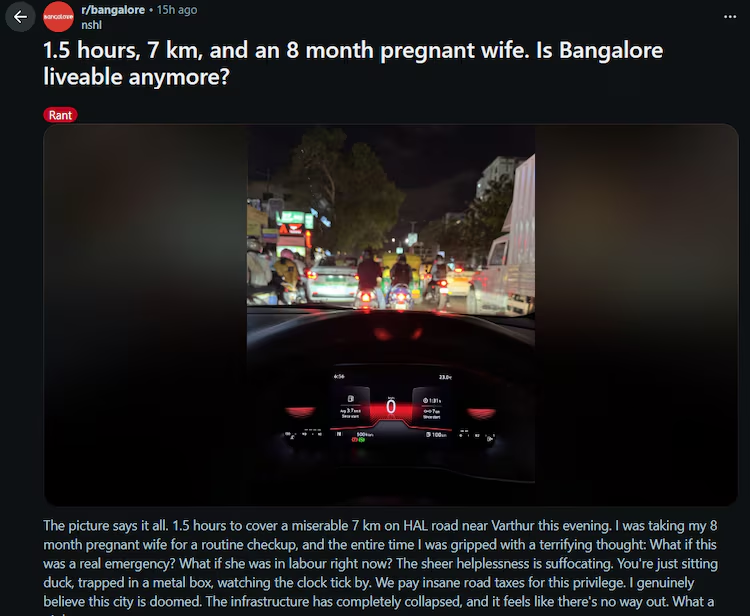
On Friday evening, Reddit user @nshl shared a gut-wrenching account on r/bangalore, the subreddit for the city’s 1.2 million residents. He was driving his wife for a routine medical checkup along HAL Road near Varthur—a stretch notorious for its perpetual gridlock. What should have been a 15-minute errand devolved into a 90-minute standstill. “The picture says it all,” he wrote, attaching a photo of his car’s dashboard clock frozen in frustration. “1.5 hours to cover a miserable 7 km… I was taking my 8-month pregnant wife for a routine checkup, and the entire time I was gripped with a terrifying thought: What if this was a real emergency?
What if she went into labour right now?”The helplessness was palpable. Stuck amid honking horns and exhaust fumes, @nshl described waves of anxiety washing over him. “I felt utterly powerless,” he confessed. “The infrastructure has completely collapsed, and it feels like there’s no way out. What a nightmare.” His post, captioned “1.5 hours, 7 km, and an 8-month pregnant wife. Is Bangalore liveable anymore?”, exploded overnight, amassing over 5,000 upvotes and hundreds of replies by Saturday morning.
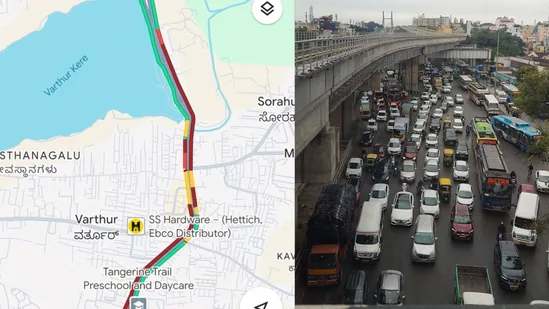
‘Our Kids Took 2 Hours to Reach School’: Bengaluru Resident’s Viral Rant on Varthur-Sarjapur Road
The anguish didn’t stop with @nshl’s ordeal. Just days later, another Bengaluru resident, Priya S., took to X to amplify the city’s traffic woes, spotlighting the Varthur-Sarjapur Road corridor—a vital artery connecting tech hubs like Whitefield and Electronic City. In a thread that garnered over 10,000 likes, Priya detailed a morning commute nightmare: “Our kids took 2 hours to reach school today, just 8 km away. Varthur-Sarjapur Road was a parking lot. Parents were late for work, kids missed their first period, and everyone’s stressed out. Is this what we signed up for in Bengaluru?”
Her post included a video of bumper-to-bumper traffic stretching past the horizon, with school buses trapped alongside IT professionals’ SUVs.Priya’s rant struck a chord, with replies flooding in from parents and commuters echoing her frustration. “My son’s school is 5 km away, but we leave at 6:30 AM to beat the rush—still takes 90 minutes,” one user wrote. Another shared a photo of students studying in a bus stuck on Sarjapur Road, captioned: “Homework in traffic—Bengaluru’s new normal.”
The thread tagged BBMP and Karnataka’s Transport Minister, demanding urgent action. Priya’s callout highlighted how traffic isn’t just an adult problem—it’s robbing children of learning time and families of sanity. “This isn’t just about roads; it’s about our quality of life,” she concluded.Varthur-Sarjapur Road’s gridlock stems from rapid urbanization outpacing infrastructure. Home to tech parks, schools, and residential complexes, the corridor handles 200,000 vehicles daily but lacks adequate flyovers or metro connectivity.
Recent rains have worsened potholes, turning stretches into slush traps. Urban mobility expert Dr. Anjali Nair notes, “Sarjapur’s traffic reflects Bengaluru’s failure to integrate transit with urban planning. Schools and offices cluster here, but roads haven’t scaled since 2010.” The viral outcry has pushed BBMP to pledge signal upgrades, but residents remain skeptical, citing years of unfulfilled promises.
Echoes of Collective Rage
The comments section on @nshl’s post, coupled with Priya’s X thread, became a cathartic outpouring of shared trauma. One user recounted leaving work at 6 PM only to arrive home three hours later, his wife calling mid-commute to say she felt unwell. “Ambulances have to travel two ways in similar traffic,” another lamented, highlighting the life-or-death stakes. A third shared: “My co-worker’s father had a heart attack; he was struggling to cover just 500 metres.” Pregnant Redditors chimed in too: “My hospital is 6 km away, but it takes an hour.
Bengaluru traffic is getting terrible day by day.”This isn’t isolated—it’s symptomatic. Bengaluru’s roads, once a punchline, are now a punch to the gut. The Diwali rush exacerbated the chaos, with officials warning of delays at hotspots like HAL Road and Sarjapur, but even increased personnel couldn’t tame the beast. As one commenter put it: “The city has reached its peak. It only gets much worse from here.”
The Tech Angle: Innovation Stifled by Gridlock
For Technocrat Magazine’s readers—engineers, CTOs, and venture capitalists—this story hits close to home. Bengaluru isn’t just a city; it’s India’s startup capital, home to over 14,000 tech firms and a $200 billion ecosystem. Yet, the traffic apocalypse is bleeding talent and productivity dry. A 2024 NASSCOM report pegged the annual economic loss from congestion at ₹60,000 crore ($7.2 billion), with commuters wasting 200 hours yearly—time that could fuel the next unicorn.
Tech giants like Infosys and Wipro mandate hybrid work partly due to commute horrors, while startups in Whitefield or Electronic City joke about “teleportation pods” as their next pitch.Kiran Mazumdar-Shaw, Biocon’s founder, amplified the discourse this week, recounting how potholes and garbage embarrassed an overseas investor. “Bengaluru’s image as a tech hub is at stake,” she tweeted. Peak XV’s Rajan Anandan went viral earlier, bemoaning a 5-hour round trip to the airport: “2.5 hours to airport, 2.5 hours to Delhi.” These aren’t anecdotes; they’re attrition drivers. A Mercer survey ranks Bengaluru low on livability, with 40% of millennials eyeing relocation to Pune or Hyderabad for sanity’s sake.
| Metric | Bengaluru Reality | Global Benchmark (e.g., Singapore) |
|---|---|---|
| Avg. Commute Time | 1.5-2 hours daily | 30-45 minutes |
| Traffic Congestion Index (TomTom 2024) | 57% delay (world’s 3rd worst) | 10-15% delay |
| Economic Loss from Traffic (Annual) | ₹60,000 crore | Minimal via smart infra |
| Tech Talent Retention Rate | 65% (down 10% YoY) | 85%+ |
Data compiled from NASSCOM, TomTom, and Mercer reports.
Root Causes: A Perfect Storm of Urban Mismanagement
Why the meltdown? Bengaluru’s population ballooned from 4 million in 1991 to 13 million today, outpacing infrastructure by decades.
The Bruhat Bengaluru Mahanagara Palike (BBMP) oversees 141 sq km of roads, but endless metro construction, unregulated real estate, and poor public transit compound the issue. HAL Road and Varthur-Sarjapur’s snarls?

A cocktail of flyover delays, flooding-prone underpasses, and festival exodus.Experts blame “siloed planning”: tech booms draw migrants, but civic bodies lag in scalable solutions like elevated corridors or AI-optimized signals. “It’s a failure of data-driven governance,” says urban planner Dr. Ravi Shankar, a former NITI Aayog advisor. “Bengaluru generates 20% of India’s traffic data—why not leverage it for predictive routing?”
Tech to the Rescue? Solutions on the Horizon
Amid the outrage, glimmers of innovation emerge. Startups like NoTraffic are piloting AI traffic lights that cut delays by 30% in pilot zones. Ola and Uber’s hyperlocal pooling apps promise efficiency, while BBMP’s ₹1,200 crore smart city push includes drone surveillance for congestion hotspots. But skeptics abound: “Band-aids on a broken system,” one Redditor quipped.
Broader fixes demand political will—expanding the Green Line Metro to Sarjapur, enforcing carpool mandates, or incentivizing remote work via tax breaks. As @nshl and Priya urged: “Immediate intervention or we’re doomed.”
A Wake-Up Call for Silicon Valley 2.0
The viral pleas from @nshl and Priya aren’t just personal; they’re a siren for Bengaluru’s tech fraternity. In a city where code deploys in seconds, human lives shouldn’t crawl at 4.67 km/h.
The posts have prompted BBMP to announce traffic audits on HAL Road and Varthur-Sarjapur, but rhetoric must yield results. As one commenter nailed it: “Bengaluru: Where dreams are built, but roads are the bottleneck.”For now, @nshl’s wife and Priya’s kids are safe—but the clock is ticking. In a city teeming with tomorrow’s innovators, yesterday’s infrastructure can’t be the roadblock. Is Bengaluru liveable? The answer hinges on whether its technocrats can debug the chaos before more families pay the price.
Technocrat Magazine invites reader solutions: Share your traffic hacks in the comments. For deeper dives into urban tech, subscribe.

Comments